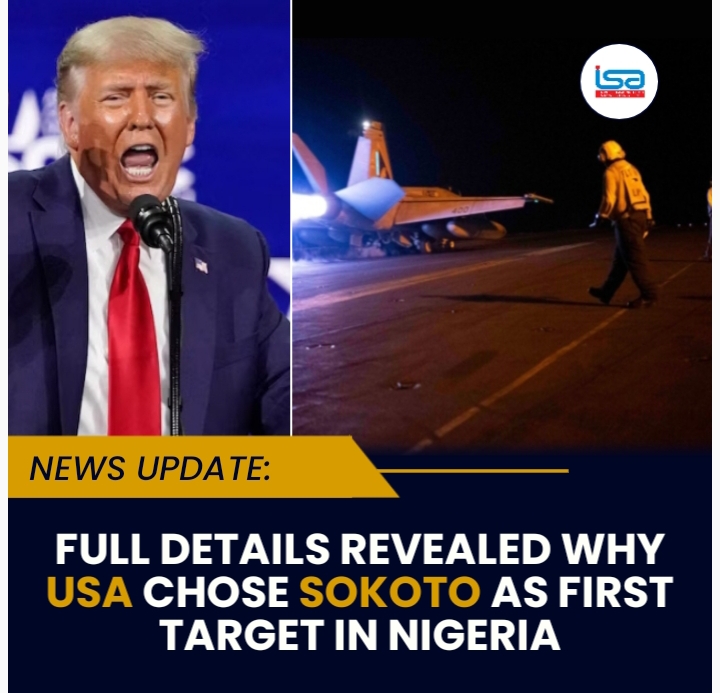
JUST IN: FULL DETAILS REVEALED ON WHY THE U.S. CHOSE SOKOTO AS FIRST TARGET IN NIGERIA

Fresh details have emerged explaining why the United States carried out its first-ever direct military strike in Nigeria in Sokoto State, rather than in the country’s more notorious conflict zones.
Security experts say the decision was not accidental but driven by strategic, intelligence, and geopolitical considerations.
EXPERT SHEDS LIGHT ON U.S. STRATEGY
International human rights lawyer and bilateral affairs expert, Emmanuel Ogebe, has explained that the choice of Sokoto was based on long-standing U.S. military familiarity with the area rather than the intensity of violence alone.
According to Ogebe, Sokoto had previously hosted U.S. special forces operations, including the 2020 rescue mission of an American hostage, which provided the U.S. military with operational knowledge of the terrain, intelligence routes, and local security dynamics.
GEOGRAPHICAL AND SECURITY ADVANTAGE OF SOKOTO
Sokoto’s location places it close to the Sahel region and Niger Republic, areas known for cross-border militant movements. Security analysts note that this proximity makes Sokoto a strategic entry and monitoring point for extremist groups attempting to infiltrate Nigeria from the wider Sahel.
Experts also point out that the U.S. already maintains surveillance and intelligence networks in the region, making military coordination faster and more precise.
WHY NOT BORNO OR THE NORTH-EAST?
Despite years of insurgency in Borno and other North-Eastern states, Ogebe stressed that Sokoto was chosen because of logistical ease and intelligence reliability, not necessarily because it is Nigeria’s most violent hotspot.
He dismissed claims that the strike was solely motivated by religious violence narratives, noting that other regions have suffered heavier civilian casualties and displacement.
DETAILS OF THE U.S. AIRSTRIKE OPERATION
The airstrikes reportedly took place in the Bauni forest area of Tangaza Local Government, targeting suspected Islamic State hideouts.
Nigerian authorities confirmed that the operation involved precision-guided munitions and was carried out with the approval of the Nigerian government. Officials stated that the strike was aimed at disrupting militant movements and preventing future attacks, while also assuring that civilian casualties were avoided.
REACTIONS AND CONTROVERSY
The strike has generated mixed reactions among residents and analysts. While federal authorities describe it as a proactive counter-terrorism move, some locals expressed surprise, stating that Sokoto has experienced more banditry than organized extremist violence in recent times.
The development has sparked broader conversations about Nigeria’s security partnerships and the increasing role of foreign powers in addressing internal security threats.
WHAT THIS MEANS FOR U.S.–NIGERIA RELATIONS
Observers say the Sokoto operation signals a new phase of U.S.–Nigeria security cooperation, especially in combating cross-border terrorism linked to the Sahel.
Analysts believe the move could lead to deeper intelligence sharing and joint operations as Nigeria continues to battle multiple security challenges across different regions.
AUTHOR
ISA POL CONSULTANCY, Information and Communication Firm