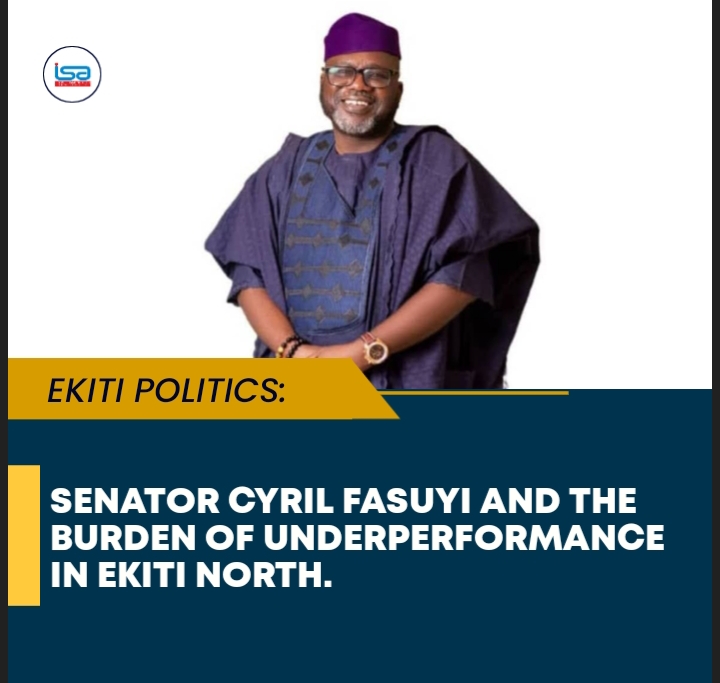
Senator Cyril Fasuyi and the Burden of Underperformance in Ekiti North


In a democracy, leadership is not judged by promises, press statements, or paperwork in the capital—it is judged by tangible results that improve the daily lives of the people. Unfortunately, for many residents of Ekiti North Senatorial District, the tenure of Cyril Fasuyi has raised more questions than answers.
Despite occupying a position that carries enormous responsibility and influence, the gap between representation and reality in Ekiti North remains painfully wide.
Infrastructure: A Region Still Left Behind
One of the most basic expectations from any elected representative is the facilitation of infrastructure development. Roads remain in poor condition across several communities in Ekiti North, making transportation difficult for farmers, traders, and students alike.
Access to clean water is still a daily struggle in many areas, while electricity supply remains inconsistent at best. These are not luxuries—they are basic necessities. Yet, years into representation, many communities cannot point to significant infrastructural projects directly influenced or attracted by their senator.
If representation is working, the evidence should be visible in roads constructed, boreholes drilled, and electricity improved. Sadly, for many constituents, that evidence is either scarce or non-existent.

Employment: Where Are the Opportunities?
Unemployment continues to plague the youth of Ekiti North. In a time when economic hardship is biting hard across Nigeria, constituents expect their senator to actively create pathways for job opportunities—whether through federal appointments, empowerment programs, or attracting investments.
However, there is little to show in terms of large-scale employment initiatives or sustainable empowerment schemes that can meaningfully reduce joblessness in the district. Many young people remain idle, frustrated, and increasingly disillusioned with the political system.
Representation should open doors. But for many in Ekiti North, those doors remain firmly shut.
Education: Neglect in a Critical Sector
Education is the backbone of any developing society, yet it appears to have received insufficient attention. Schools in parts of the district continue to face challenges such as poor infrastructure, inadequate learning materials, and lack of support.
While there are talks of proposed institutions and legislative efforts, the reality on ground tells a different story. A bill for a federal institution is not the same as a functioning school. Until such projects materialize and begin to benefit students, they remain mere proposals.
Students and parents deserve more than promises—they deserve action.
Youth Empowerment: Missing in Action
In a region filled with energetic and ambitious young people, the lack of structured empowerment programs is deeply concerning. Youth empowerment should go beyond occasional handouts or politically motivated gestures. It should involve skills acquisition, funding opportunities, mentorship, and long-term development strategies.
Unfortunately, many youths in Ekiti North cannot point to any consistent, impactful empowerment initiative driven by their2024 representation at the Senate.
A generation full of potential is being left without direction, and that is a failure that cannot be ignored.
Bills vs Real Impact
Supporters often point to bills sponsored as evidence of performance. But let’s be clear: sponsoring bills is a fundamental responsibility of every senator—it is not an extraordinary achievement.
More importantly, many of these bills are still in early stages and have not translated into real-life benefits for the people of Ekiti North. Governance is not about activity in Abuja; it is about impact at home.
The Reality Check
The role of a senator is not ceremonial. It is a position that demands proactive engagement, strategic influence, and a relentless focus on delivering development to constituents.
When roads remain bad, jobs are scarce, schools are struggling, and youths feel abandoned, it becomes difficult to argue that representation has been effective.
Conclusion: Accountability Must Come First
Democracy thrives on accountability. The people of Ekiti North deserve to ask tough questions and demand better from their elected officials.
This is not about politics or personal attacks—it is about performance.
Until there is clear, measurable, and visible improvement in infrastr
ucture, the employment, education, and youth empowerment, the concerns about underperformance will continue to grow louder.
Senator Cyril Fasuyi and the Burden of Underperformance in Ekiti North
In a democracy, leadership is not judged by promises, press statements, or paperwork in the capital—it is judged by tangible results that improve the daily lives of the people. Unfortunately, for many residents of Ekiti North Senatorial District, the tenure of Cyril Fasuyi has raised more questions than answers.
Despite occupying a position that carries enormous responsibility and influence, the gap between representation and reality in Ekiti North remains painfully wide.
Infrastructure: A Region Still Left Behind
One of the most basic expectations from any elected representative is the facilitation of infrastructure development. Roads remain in poor condition across several communities in Ekiti North, making transportation difficult for farmers, traders, and students alike.
Access to clean water is still a daily struggle in many areas, while electricity supply remains inconsistent at best. These are not luxuries—they are basic necessities. Yet, years into representation, many communities cannot point to significant infrastructural projects directly influenced or attracted by their senator.
If representation is working, the evidence should be visible in roads constructed, boreholes drilled, and electricity improved. Sadly, for many constituents, that evidence is either scarce or non-existent.
Employment: Where Are the Opportunities?
Unemployment continues to plague the youth of Ekiti North. In a time when economic hardship is biting hard across Nigeria, constituents expect their senator to actively create pathways for job opportunities—whether through federal appointments, empowerment programs, or attracting investments.
However, there is little to show in terms of large-scale employment initiatives or sustainable empowerment schemes that can meaningfully reduce joblessness in the district. Many young people remain idle, frustrated, and increasingly disillusioned with the political system.
Representation should open doors. But for many in Ekiti North, those doors remain firmly shut.
Education: Neglect in a Critical Sector
Education is the backbone of any developing society, yet it appears to have received insufficient attention. Schools in parts of the district continue to face challenges such as poor infrastructure, inadequate learning materials, and lack of support.
While there are talks of proposed institutions and legislative efforts, the reality on ground tells a different story. A bill for a federal institution is not the same as a functioning school. Until such projects materialize and begin to benefit students, they remain mere proposals.
Students and parents deserve more than promises—they deserve action.
Youth Empowerment: Missing in Action
In a region filled with energetic and ambitious young people, the lack of structured empowerment programs is deeply concerning. Youth empowerment should go beyond occasional handouts or politically motivated gestures. It should involve skills acquisition, funding opportunities, mentorship, and long-term development strategies.
Unfortunately, many youths in Ekiti North cannot point to any consistent, impactful empowerment initiative driven by their2024 representation at the Senate.
A generation full of potential is being left without direction, and that is a failure that cannot be ignored.
Bills vs Real Impact
Supporters often point to bills sponsored as evidence of performance. But let’s be clear: sponsoring bills is a fundamental responsibility of every senator—it is not an extraordinary achievement.
More importantly, many of these bills are still in early stages and have not translated into real-life benefits for the people of Ekiti North. Governance is not about activity in Abuja; it is about impact at home.
The Reality Check
The role of a senator is not ceremonial. It is a position that demands proactive engagement, strategic influence, and a relentless focus on delivering development to constituents.
When roads remain bad, jobs are scarce, schools are struggling, and youths feel abandoned, it becomes difficult to argue that representation has been effective.
Conclusion: Accountability Must Come First
Democracy thrives on accountability. The people of Ekiti North deserve to ask tough questions and demand better from their elected officials.
This is not about politics or personal attacks—it is about performance.
Until there is clear, measurable, and visible improvement in infrastructure, employment, education, and youth empowerment, the concerns about underperformance will continue to grow louder.
Leadership is not defined by intentions or paperwork—it is defined by results.
And for many in Ekiti North, those results are still missing.
Leadership is not defined by intentions or paperwork—it is defined by results.
And for many in Ekiti North, those results are still missing.
Comrade Idowu Afuye,
CEO, ISAPOL CONSULTANCY INFORMATION COMMUNICATION FIRM.

![THE BAO WALK- [12.0] SIMPLY UNFORGETTABLE #lEXPERIENCE- FROM IYIN -IGEDE- AWO [ PRE ] AND FIRST BAPTIST CHURCH, IGEDE TO EGIRI OKE IN IYIN KINGDOM ON THE D DAY](https://www.isapolmedia.com.ng/wp-content/uploads/2026/03/Screenshot_20260323-132721-75x75.jpg)