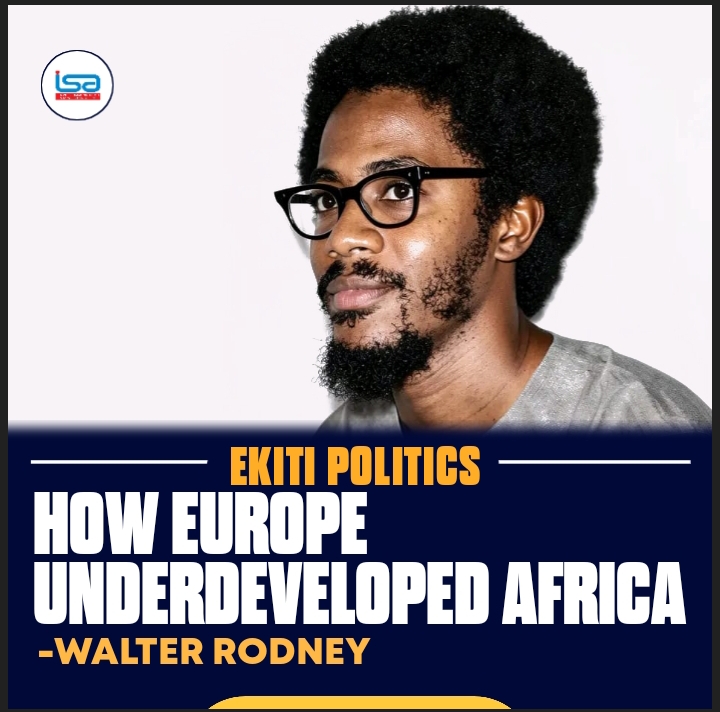
How Europe underdeveloped Africa – Walter Rodney

Walter Rodney was not just a scholar—he was a disruptor of comfortable lies. The kind of thinker who didn’t just study history… he challenged who had the power to write it.
Born in 1942 in Georgetown, Guyana—then still shaped by colonial rule—Rodney grew up in a world where inequality wasn’t hidden. It was structured. Visible. Normalized.
But he refused to accept it as normal.
From the classrooms of the University of the West Indies to SOAS University of London, Rodney sharpened his mind with one purpose: to understand the roots of Black struggle—not as isolated events, but as part of a global system.
And then—he told the truth about it.
His groundbreaking work, How Europe Underdeveloped Africa, wasn’t just academic—it was revolutionary. Rodney dismantled centuries of distortion and made one thing clear:
Africa’s condition was not accidental.
It was engineered.
Through colonial extraction.
Through economic manipulation.
Through systems designed to enrich Europe while draining Africa.
That kind of truth doesn’t sit quietly.
It travels.
It unsettles.
It awakens.
Rodney didn’t keep his knowledge locked in lecture halls. Whether in Tanzania at the University of Dar es Salaam or among working-class communities in the Caribbean, he believed education belonged to the people.
Not just the privileged.
Not just the academic elite.
The people.
He spoke in ways that connected history to lived reality—so that everyday Black men and women could see their struggles not as personal failures, but as part of a larger system that needed to be challenged.
And that made him dangerous.
In 1968, his ideas shook Guyana so deeply that the government banned him from returning home. But exile didn’t quiet him—it expanded him. His voice grew louder across borders, across movements, across generations.
Because Rodney understood something many fear to confront:
You cannot dismantle oppression without first understanding how it was built.
When he finally returned to Guyana, he didn’t come back softened.
He came back sharper.
Still organizing.
Still teaching.
Still demanding accountability.
And in 1980, at just 38 years old, Walter Rodney was assassinated in a car bombing.
A life taken.
But a message already too powerful to erase.
Because Rodney didn’t just leave behind books.
He left behind clarity.
He gave people language for their condition.
He gave movements intellectual backbone.
He gave history back to those it was taken from.
Today, his influence lives on in every conversation about decolonization, in every movement demanding economic justice, in every mind that refuses to accept the world as it is without asking why.
Walter Rodney reminds us:
Knowledge is not neutral.
History is not harmless.
And truth—real truth—will always come at a cost.
But it is still worth telling.
Comrade Afuye Idowu
ISA POL COMMUNICATIONS & CONSULTANCY FIRM