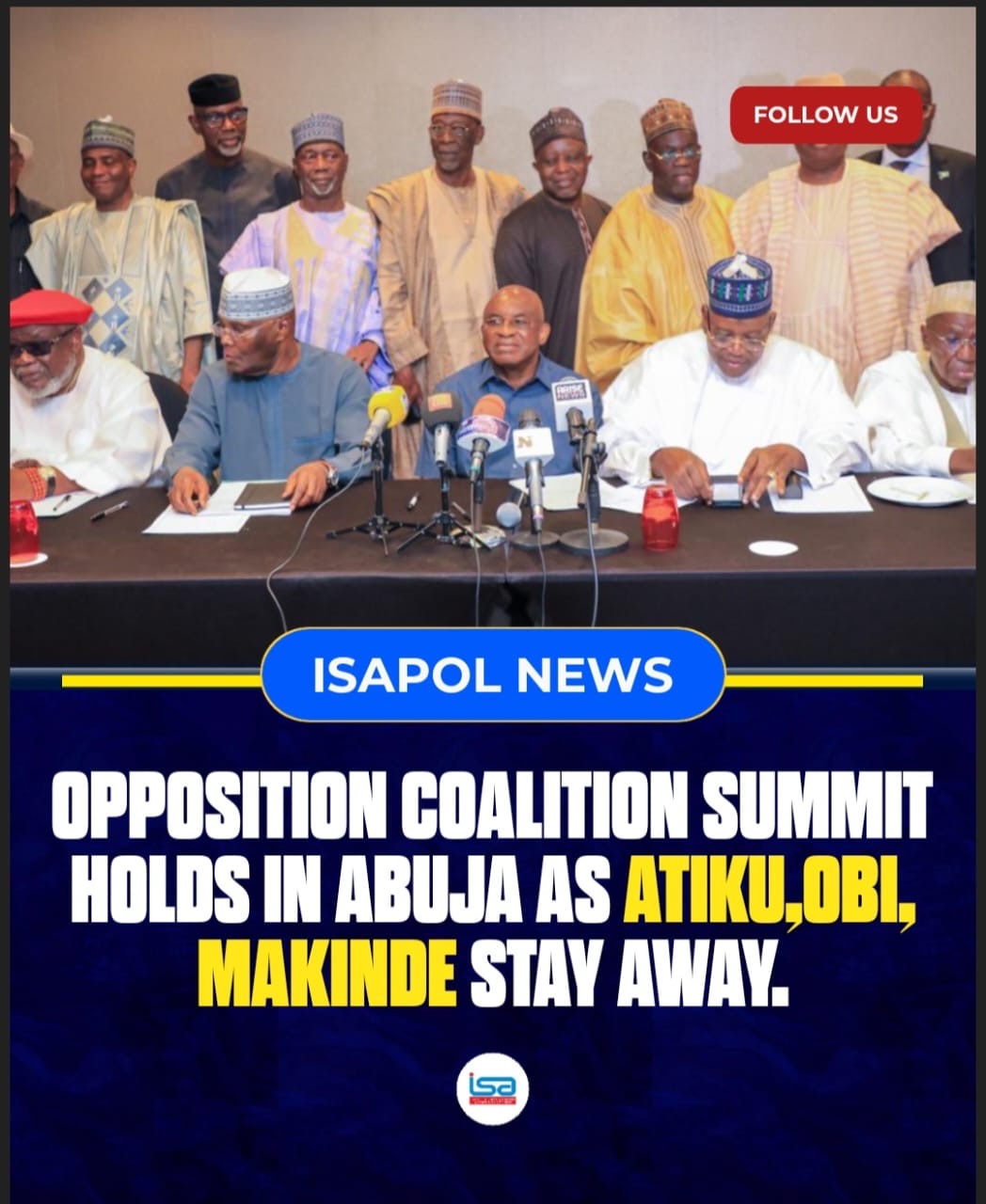
Opposition Coalition Summit Holds in Abuja as Atiku, Obi, Makinde Stay Away

A major opposition coalition summit aimed at strengthening cooperation ahead of the 2027 general elections was held in Abuja on Monday, but some of the leading political figures associated with the emerging alliance were conspicuously absent.
Among those who did not attend were former Vice President and African Democratic Congress (ADC) presidential candidate, Atiku Abubakar; former Anambra State Governor and Nigeria Democratic Congress (NDC) presidential candidate, Peter Obi; and Oyo State Governor, Seyi Makinde.
The meeting, held at the Shehu Musa Yar’Adua Centre, nevertheless attracted several prominent opposition politicians and representatives of participating political parties.
Those in attendance included Social Democratic Party (SDP) presidential candidate Adewole Adebayo, Peoples Redemption Party (PRP) presidential candidate Donald Duke, and Allied Peoples Movement (APM) vice-presidential candidate Lawal Musa Daura.
Representatives of the National Working Committees and Boards of Trustees of the participating parties also took part in the summit.
The gathering brought together representatives of six opposition parties — the African Democratic Congress (ADC), Allied Peoples Movement (APM), Nigeria Democratic Congress (NDC), Peoples Democratic Party (PDP), Peoples Redemption Party (PRP), and Social Democratic Party (SDP).
Speaking on behalf of the G100, former APC chieftain Salihu Lukman presented a proposed framework for cooperation among the opposition parties, with the broader objective of establishing what he described as a “Government of National Competence.”
Lukman argued that the proposed coalition should be built around competence, integrity, national inclusion and equitable representation among the parties involved.
He also proposed that any coalition government should operate for a single four-year transition period, with the arrangement formally captured in an enforceable Transition Charter.
According to him, relying solely on verbal agreements would not be sufficient, particularly given the history of political alliances in Nigeria where commitments have sometimes been abandoned after elections.
Lukman therefore called for all agreements reached by the opposition parties to be properly documented and supported by clear accountability mechanisms and consequences for any breach.
He stressed that the coalition should not simply become an alliance of political ambitions, but should evolve into a credible and structured platform capable of delivering competent, accountable and inclusive governance.
The G100 convener urged opposition leaders to place national interest above individual political ambitions and concentrate on developing a framework that would guarantee accountability, inclusiveness and commitment among all participating parties as preparations for the 2027 elections gather momentum.
Published by:
Isa Pol Consultancy Information and Communication Firm