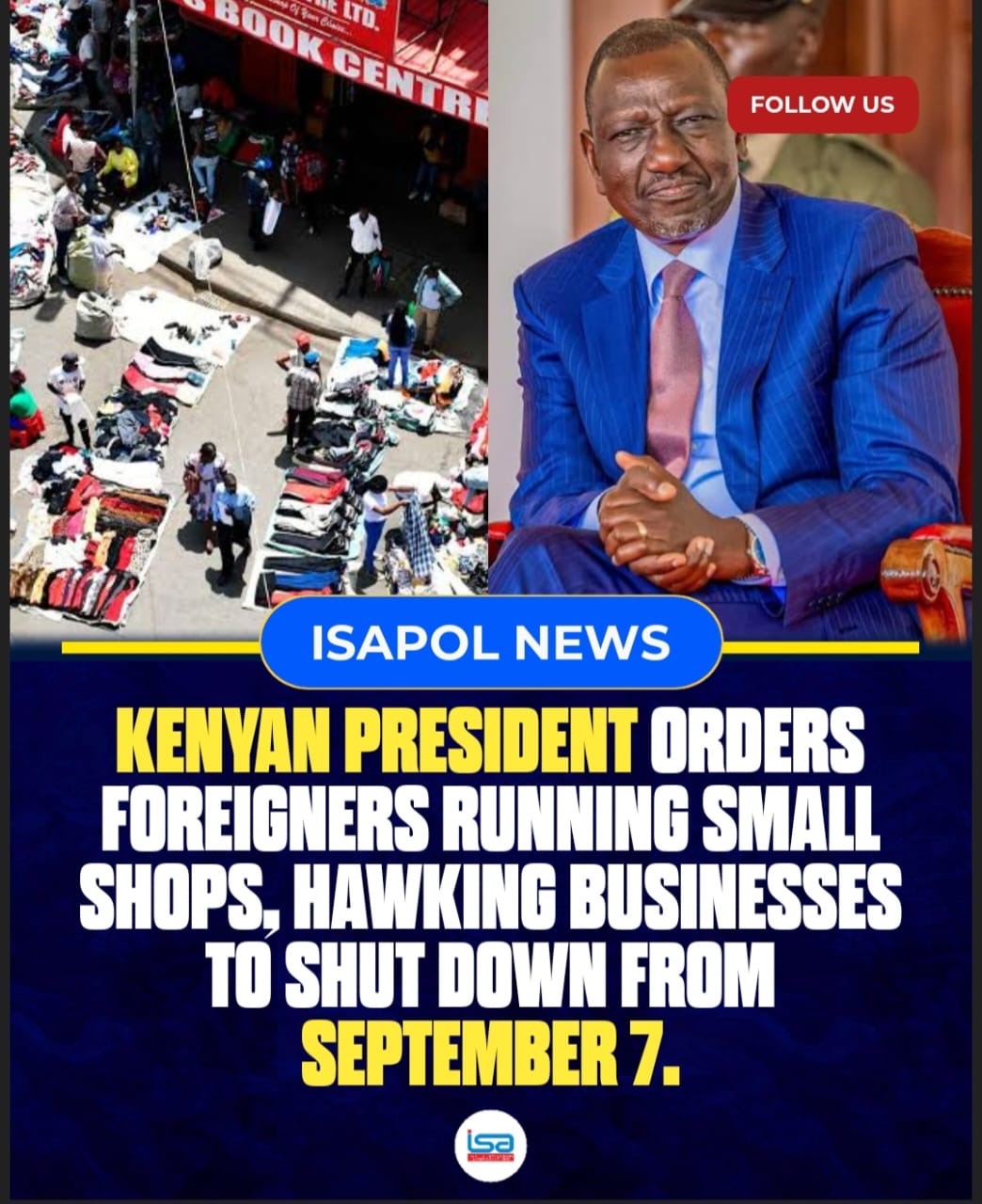
KENYAN PRESIDENT ORDERS FOREIGNERS RUNNING SMALL SHOPS, HAWKING BUSINESSES TO SHUT DOWN FROM SEPTEMBER 7
_Crackdown Aimed at “Protecting Local Traders” Sparks Debate on Xenophobia, Trade Policy, and Regional Integration_

President William Ruto has ordered all foreigners operating small retail shops, kiosks, and hawking businesses across Kenya to cease operations by September 7, 2026, in what the government is calling a major enforcement drive to protect Kenyan-owned micro enterprises.
The directive was issued on Wednesday during a meeting with representatives of the Kenya National Traders Association in State House, Nairobi.
WHAT THE PRESIDENT SAID
President Ruto said the government had received “numerous complaints” from Kenyan traders that foreigners were dominating sectors reserved for citizens under the Kenya Investment Act and County Trade Licensing laws.
“From September 7, we will enforce the law. Foreigners must exit businesses in the retail, hawking, and small-scale trading sector. These are areas reserved for Kenyans. We cannot have a situation where our mothers and fathers who wake up at 4am to sell vegetables are pushed out of business,” Ruto stated.
He added that foreigners are welcome to invest in Kenya, but only in capital-intensive sectorsbthat create jobs and bring technology transfer — such as manufacturing, agro-processing, ICT, and large-scale retail.
The President directed the Ministry of Interior, County Governments, and the Kenya Revenue Authority to conduct joint enforcement operations starting September 7.
SCOPE OF THE CRACKDOWN
According to the directive, the following will be affected:
– Small retail shops in estates, markets, and CBDs selling groceries, electronics, clothes, and household goods
– Street hawking and vending in major towns including Nairobi, Mombasa, Kisumu, and Nakuru
– Open-air markets and kiosks traditionally dominated by Kenyan traders
The government said foreigners with valid Class D and Class G investment licenses for large-scale businesses will not be affected. Those with work permits tied to employment in companies will also be exempt.
County commissioners have been ordered to compile lists of affected businesses and issue final notices before enforcement begins.
REASON BEHIND THE ORDER
Government officials cited 3 key reasons:
1. Economic Protectionism: To safeguard livelihoods of Kenyan traders who say they are being undercut by foreigners with access to cheaper imports and pooled capital.
2. Regulatory Compliance: Many foreigners were allegedly operating on tourist visas or without proper business permits, and evading taxes.
3. Political Pressure: The Kenya National Traders Association has staged several protests in 2025 and 2026 demanding action, arguing that “micro-trade is the last frontier for ordinary Kenyans.”
Trade CS Rebecca Miano said: “Kenya is open for business, but not at the expense of our small traders. There must be balance between FDI and local enterprise protection.”
WHO WILL BE MOST AFFECTED?
The order is expected to impact thousands of traders, mostly from:
– Somalia, Ethiopia, Uganda, Tanzania, Rwanda — operating in Eastleigh, Gikomba, and border towns
– China, India, Pakistan — running small electronics and textiles shops
– West African nationals — in mitumba and cosmetics retail
Many of them have lived in Kenya for over 10 years and employ Kenyans.
REACTIONS AND CONTROVERSY
The announcement has triggered mixed reactions:
Supporters — Kenyan traders’ associations hailed it as “long overdue.”
“Finally the government is listening. Our people deserve first priority in small business,” said KENATA Chairman, Wilfred Marube.
Critics— Human rights groups and EAC officials warned it could violate EAC Common Market Protocol on free movement of labor and establishment of business.
The Kenya Human Rights Commission called it “a dangerous slide into economic xenophobia.”
Foreign Missions — The Somali and Ethiopian embassies have reportedly requested urgent meetings with the Ministry of Foreign Affairs to seek clarification and possible exemption for long-term residents.
Economists are also divided. Some argue it will free up space for Kenyans, while others warn it could disrupt supply chains and lead to price hikes in certain goods.
LEGAL AND REGIONAL IMPLICATIONS
Under the EAC Common Market Protocol, citizens of member states are allowed to establish businesses in other member states. Legal experts say blanket evictions without due process could trigger diplomatic disputes.
The Kenya Investment Authority clarified that the directive targets “micro and small enterprises below the investment threshold of $100,000” as stipulated in the Investment Act.
The Law Society of Kenya said it will monitor enforcement to ensure no violations of constitutional rights to livelihood and non-discrimination.
WHAT HAPPENS NEXT
1. September 1-6: County officials to serve notices and verify business licenses.
2. September 7: Joint enforcement by police, county askaris, and KRA to begin. Defaulters risk arrest, fines, and deportation.
3. Post-September 7: Government says it will launch a “Buy Kenya, Build Kenya” fund to provide affordable credit to Kenyan traders taking over vacated spaces.
President Ruto concluded: “We are not chasing investors. We are protecting our people. Kenya must work for Kenyans first.”
BOTTOM LINE
The September 7 deadline marks one of Kenya’s toughest stances on small-scale foreign traders. While framed as economic empowerment, the policy risks straining regional ties, triggering legal challenges, and reshaping the informal economy.
ISAPOL MEDIA will monitor enforcement and its impact on markets across Kenya. PUBLISHED BY: ISAPOL CONSULTANCY INFORMATION COMMUNICATION FIRM