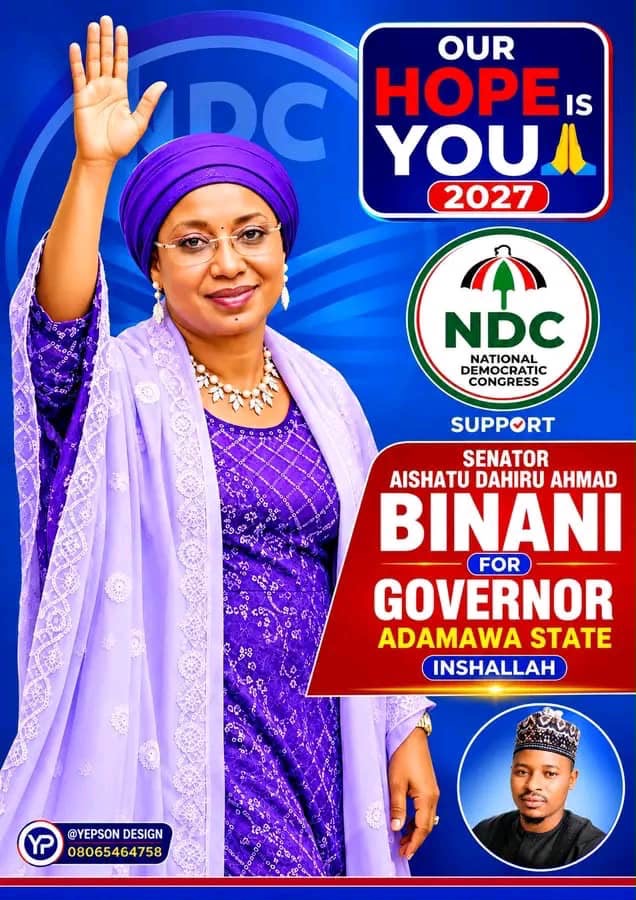
FROM ENGINEERING TO PUBLIC SERVICE: THE EDUCATIONAL FOUNDATION OF SENATOR AISHAATU DAHIRU AHMED BINANI

Education gives people more than qualifications. It develops discipline, broadens understanding and creates the intellectual tools needed to engage with the challenges of a changing society.
Senator Aishatu Dahiru Ahmed Binani’s educational journey is particularly notable for its combination of technical education, technology, business management and practical professional development.
A FOUNDATION IN TECHNICAL EDUCATION
Senator Binani began her education at Gwadabawa Primary School in Jimeta before proceeding to Government Secondary School, Yola.
She later attended the Federal Polytechnic, Mubi, where she obtained both an Ordinary National Diploma and a Higher National Diploma in Electrical and Electronics Engineering.
A background in engineering can develop analytical thinking, problem solving and an appreciation for how systems function.
These qualities can be valuable in public responsibility, where many community challenges require structured thinking and practical solutions.
EDUCATION BEYOND THE CLASSROOM
Her educational development also extended beyond engineering.
She obtained a certificate in Rural Radio Systems from the University of Southampton in the United Kingdom and pursued further studies in Business Management at Nasarawa State University.
She also acquired training in Data Processing, adding a technological dimension to her educational profile.
This combination demonstrates the value of developing knowledge across different areas rather than limiting one’s intellectual development to a single discipline.
WHERE ENGINEERING MEETS DEVELOPMENT
Engineering is closely connected to development.
Electricity, communications, technology and infrastructure all play important roles in the functioning of modern communities.
An understanding of electrical and electronics engineering can therefore provide useful insight into technological infrastructure and the systems that support economic and social activity.
When such technical knowledge is combined with business management, it can also encourage an appreciation of both practical implementation and organisational decision making.
THE IMPORTANCE OF TECHNOLOGY
Technology continues to reshape government, business and everyday life.
Knowledge of data processing and communication systems can help broaden an understanding of the opportunities presented by digital transformation.
For public service, technological awareness can contribute to conversations around digital inclusion, information management, communication and modern service delivery.
EDUCATION AND THE PEOPLE
The ultimate purpose of education is not simply personal advancement. Knowledge becomes more valuable when it can contribute to solving problems and improving society.
Senator Binani’s educational background brings together engineering, technology and business management, creating a multidisciplinary foundation that can inform her understanding of development.
Such knowledge can be particularly useful when examining issues involving infrastructure, technology, economic opportunity and institutional development.
A CONTINUOUS JOURNEY OF LEARNING
A strong educational journey is one that continues to evolve.
From foundational schooling to technical education, international exposure, business management and technological training, Senator Binani’s academic development reflects the importance of continuous learning.
In public responsibility, continuous learning can encourage leaders to remain open to innovation, new ideas and changing societal needs.
KNOWLEDGE AS A RESOURCE FOR DEVELOPMENT
Education provides the foundation from which ideas can grow.
For Senator Aishatu Dahiru Ahmed Binani, her background in Electrical and Electronics Engineering, combined with further education in rural communication systems, business management and data processing, offers a broad intellectual platform.
When technical knowledge is combined with management understanding and public responsibility, it can become a useful resource for engaging the challenges of modern governance and community development.
PUBLISHED BY: ISAPOL CONSULTANCY INFORMATION COMMUNICATION FIRM