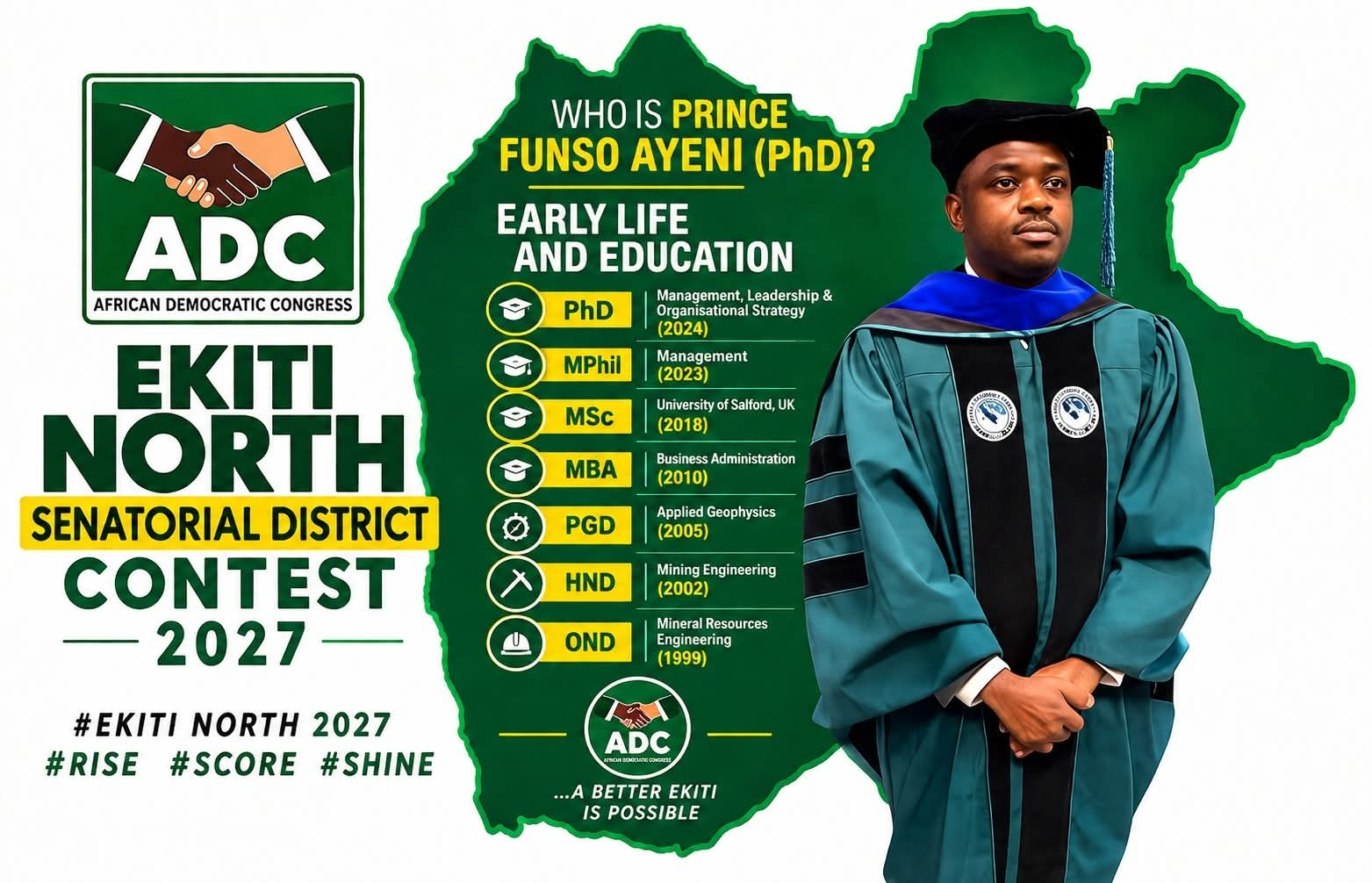
DR. FUNSO AYENI, PhD: NATION-BUILDING, INSTITUTIONAL STRENGTH AND THE FUTURE OF EFFECTIVE REPRESENTATION FOR EKITI NORTH

As Nigeria approaches another critical electoral cycle, the discourse around governance is shifting from mere political contests to more fundamental questions: What kind of leadership do we need? How strong are our institutions? And can elected representatives effectively translate the yearnings of their people into tangible legislative and policy outcomes?
It is within this context that Prince Dr. Funso Ayeni, PhD, presents his aspiration to represent the Ekiti North Senatorial District — encompassing Ikole, Oye, and other key communities — in the Senate of the Federal Republic of Nigeria. His candidacy invites a broader reflection on what quality representation must entail in 2027 and beyond.
1. REDEFINING REPRESENTATION: BEYOND THE SEAT
Effective senatorial representation extends far beyond holding office or attending plenary. It demands a legislator who is deeply rooted in the realities of his people, intellectually equipped for lawmaking, and strategically positioned to influence national policy in favor of his constituency.
A senator must serve as a bridge between government and the grassroots — articulating local challenges at the national level, and bringing federal opportunities back home.
For Ekiti North, the development priorities are clear and urgent:
Infrastructure deficit, quality education, accessible healthcare, youth empowerment, job creation, agricultural modernization, rural transformation, and expanded economic opportunities.
Meeting these demands requires a representative with both legislative competence and a genuine commitment to constituency engagement.
2. NATION-BUILDING THROUGH HUMAN CAPITAL DEVELOPMENT
True nation-building starts with people. A country cannot progress if its human capital remains underdeveloped. The future of Ekiti North and Nigeria at large depends on deliberate investment in education, vocational training, entrepreneurship, innovation, and technology adoption.
A forward-thinking representative must champion legislative advocacy and policy interventions that:
1. Expand access to quality education and digital skills for youths
2. Support women-led businesses and vulnerable groups
3. Attract federal programs and partnerships that create jobs and foster self-reliance
Through constituency outreach, scholarship schemes, and skills acquisition programs, representation can become a direct vehicle for lifting families out of poverty and building a productive workforce.
3. STRENGTHENING RURAL ECONOMIES AND COMMUNITY RESILIENCE
A significant population of Ekiti North is agrarian and relies on small-scale businesses for survival. Yet, rural communities continue to grapple with poor road networks, inadequate healthcare facilities, dilapidated schools, unstable power supply, water scarcity, and limited access to markets.
Sustainable development cannot be urban-centric. Effective representation must ensure that national budgets, federal projects, and policy frameworks are deliberately aligned with the needs of rural dwellers.
This means pushing for rural road rehabilitation, primary healthcare revitalization, agricultural support systems, and rural electrification — initiatives that will unlock productivity and stem rural-urban migration.
4. A VISION-DRIVEN APPROACH TO THE 2027 MANDATE
The 2027 elections present the people of Ekiti North with a defining choice. The electorate must interrogate candidates not just on political affiliations, but on vision, track record, policy clarity, intellectual capacity, and understanding of grassroots challenges.
Dr. Funso Ayeni’s proposition is anchored on nation-building, responsible leadership, and evidence-based representation. With his background in leadership strategy, governance, and community service, his candidacy represents a call for a new model of politics — one driven by ideas, competence, and service delivery rather than rhetoric.
CONCLUSION
Ultimately, the mandate lies with the people of Ekiti North. The quality of representation they elect will determine the pace of development not only within the senatorial district but also across Ekiti State and Nigeria.
In a time when Nigeria needs legislators who can think nationally and act locally, the conversation must be about capacity, character, and commitment to nation-building.
PUBLISHED BY:
ISAPOL CONSULTANCY INFORMATION COMMUNICATION FIRM