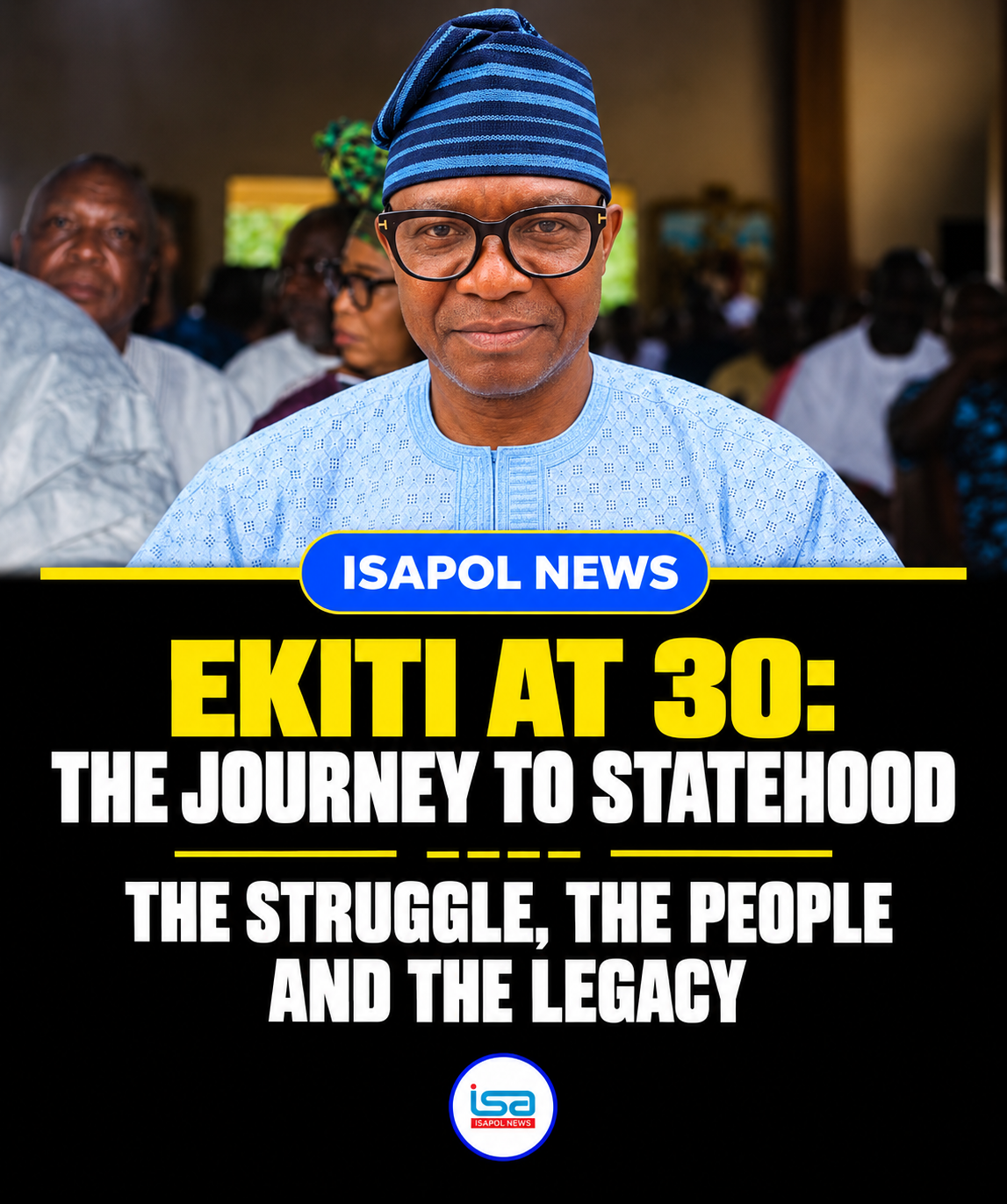
EKITI AT 30: THE JOURNEY TO STATEHOOD —- THE STRUGGLE, THE PEOPLE AND THE LEGACY

By Hon. Dr. Ife Arowosoge
I warmly salute and congratulate the good people of Ekiti State as we celebrate 30 years of the creation of our dear Ekiti State. This is not only a moment for celebration, but also an opportunity to reflect on the history, sacrifices and struggles that eventually gave birth to the state on 1 October 1996.
The brief account I am presenting today is particularly directed at the younger generation of Ekiti. Those who were about ten years old when Ekiti State was created in 1996 are today full-grown adults, many of whom may know little or only fragments of the long journey that preceded the creation of the state. It is therefore important that they have access to a correct, clear and chronological account of the struggle, presented in a nutshell, so that they can understand where we came from, appreciate the efforts of those who contributed to the struggle, and preserve the history for generations yet unborn.
As we celebrate Ekiti at 30, therefore, let us remember that the state we enjoy today did not emerge by accident. It was the product of years of agitation, advocacy, political action, consultations, organisation and sacrifice by people who believed that the Ekiti people deserved a state of their own.
What follows is a brief attempt to put the struggle into a chronological perspective and to acknowledge some of the principal individuals and organisations that played significant roles in the journey.
*FIRST PHASE* : 1980–1983 — THE BEGINNING OF THE STRUGGLE
A natural question arises: Why did the Ekiti people begin agitating for their own state in 1980, only four years after the creation of Ondo State in 1976, the state to which they belonged?
The answer lies largely in what the Ekiti people perceived as unexpected and disproportionate marginalisation within the newly created Ondo State—marginalisation which, in their view, was even greater than what they had experienced in the old Western Region.
At the time, the Ekiti population constituted approximately *52 per cent* of the population of Ondo State, while the non-Ekiti areas constituted about *48 per cent.* Yet, according to the perception of the Ekiti leadership at the time, the distribution of political appointments, budgetary resources and industrial projects did not reflect this demographic weight.
Rather than treating Ondo State broadly as comprising two major components—Ekiti and non-Ekiti—the Ekiti people believed that the state was, in practice, being treated as though it consisted of five imaginary regions: Akoko, Akure/Owo, Ondo/Idanre, Okitipupa/Igbokoda and Ekiti.
In this arrangement, Ekiti felt that it was being treated as merely one of five units, rather than as a component representing more than half of the state’s population.
This perceived imbalance became particularly contentious following the first budget of Chief Adekunle Ajasin’s administration in 1979. The Ekiti leadership protested what it regarded as inadequate consideration of Ekiti’s population and contribution to the state.
Rather than resolving the disagreement through dialogue, the response of the government was perceived by the Ekiti leaders as heavy-handed.
The controversy reportedly included criticism of the accuracy of the population figures attributed to Ekiti, with suggestions that the population had been exaggerated or “bloated.”
This development caused considerable resentment among Ekiti leaders. They questioned why a population that had been politically important during elections could subsequently be regarded as exaggerated when questions of representation and resource allocation arose.
The argument that emerged was straightforward: if Ekiti’s population was considered sufficiently large to provide substantial electoral support, then that same population should be recognised in the allocation of political positions, resources and development projects.
If, on the other hand, the population was considered too large to be accommodated fairly within Ondo State, then Ekiti, in the view of the agitators, had sufficient demographic strength to justify the creation of a separate state.
It was against this background that the first organised demand for Ekiti State began to take shape.
The agitation was led by the then Deputy Governor of Ondo State, Chief Akin Omoboriowo, who, together with Dr. Bode Olowoporoku and other Ekiti leaders, pursued the demand for a separate state.
A formal request for the creation of Ekiti State was subsequently prepared and submitted through Chief Adekunle Ajasin, the Governor of Ondo State, to the Federal Government. This marked a significant turning point in the history of the agitation.
The Governor’s reaction was, however, described by the Ekiti agitators as hostile. Rather than allowing the demand to develop into a broader political discussion, the government took disciplinary action against some of the leading figures associated with the agitation. Several prominent Ekiti sons and daughters subsequently suffered removal from public offices or other forms of official pressure because of their support for the creation of Ekiti State.
Among those affected were:
Dr. Bode Olowoporoku of Ilawe-Ekiti — removed as Commissioner for Statistics and Economic Planning.
Chief Babatunde of Ado-Ekiti — removed as Commissioner for Health
Chief Falodun of Ayede — removed as Commissioner for Education.
Chief Babatola, the Olora of Ado-Ekiti — removed as Chairman of a state parastatal. He had previously served as a Minister in the First Republic.
Prince Adebanbi
Adefajo —removed as Chairman of Water Corporation Board.
There were also members of the Ondo State House of Assembly of Ekiti extraction who quietly supported and cooperated with the agitation. However,
some Ekiti people believed that the agitators were overly ambitious and excessively impatient in their pursuit of the struggle.
The events of this early phase created an unresolved political crisis within the leadership of the Unity Party of Nigeria (UPN) and eventually contributed to the decision by some of the leading agitators to leave the UPN and join the National Party of Nigeria (NPN).
Their move was not only a response to their dissatisfaction with the handling of the Ekiti State agitation for fair treatment , but also a strategic decision to challenge the Governor and the UPN government in subsequent elections. This political realignment marked an important turning point in the evolution of the struggle for the creation of Ekiti State.
Thus, what began in 1980 as a reaction to perceived political and developmental marginalisation soon developed into a broader and more determined campaign for self-government.
The confrontation of this period did not extinguish the demand for Ekiti State. Instead, it strengthened the resolve of its proponents and laid the foundation for the more organised phases that followed.
The events of 1980–1983 therefore marked the beginning of a struggle that would ultimately last sixteen years, culminating in the creation of Ekiti State on 1 October 1996.
*SECOND PHASE: THE BIRTH OF “THE CONFEDERATE*” , 1988–1990
On 31 December 1983, the military junta led by Major General Muhammadu Buhari took over the government through a coup d’état. Following the coup, several prominent political figures, including Governor Adekunle Ajasin, Chief Akin Omoboriowo, and Chief Olowoporoku, who had been appointed Minister of Science and Technology by President Shehu Shagari of the National Party of Nigeria (NPN), were arrested and detained at Kirikiri Maximum Security Prison in Lagos. They remained in detention for about two years, until the palace coup of August 1985, when General Ibrahim Badamasi Babangida overthrew Buhari’s government and released many political detainees, partly as an effort to gain the support of the political class.
A few years after the trauma of imprisonment had subsided, the Confederate Movement emerged to continue the agitation for the creation of Ekiti State, but this time under the guidance and direction of Ekiti traditional rulers.
*Chairman of the Organisation* :
His Royal Majesty , Oba Adegboye Akaiyejo, the Ogoga of Ikere-Ekiti
*Convener* :
Dr. Chief Bode Olowoporoku
*Prominent Leaders* :
Chief Jonny Ajayi of Ikole
Prince Adebanbi Adefajo of Moba
Chief Oladeji Fasuan of Afao
Alhaji Chief Baasaya Shehu Ajijola of Ado-Ekiti
Chief O. Okeya of Ise/Emure, Chief Mrs Bola Omojola, Mrs Onipede among others
Though The Confederate provided an important platform through which the agitation survived during a period when conventional political organisation was prohibited, detractors portrayed the agitation as a political gathering, petitioned the Government, prompting the State Security Service (SSS) to go after the leadership of the organisation, particularly Dr. Bode Olowoporoku, who was a banned politician at the time. The SSS subsequently barricaded the Ogoga’s Palace in Ikere-Ekiti for several months, effectively disrupting the activities of the organisation and bringing the Confederate movement to a halt.
*THIRD PHASE: 1991–1996*
The third phase saw the emergence of more structured organisations dedicated to the creation of Ekiti State following the lifting of the ban on political activities. Four organisations were established, each with distinct objectives but united by a common mission. These organisations included
*THE EKITI GRAND ALLIANCE (EGA)*
Established: 1991
The Ekiti Grand Alliance was essentially an elite and leaders’ organisation devoted to advancing the cause of Ekiti State creation. Its membership brought together prominent academics, professionals, politicians, community leaders, and influential citizens. The aim was to convince ourselves on the need to speak with one voice and share a common commitment to the political emancipation and development of Ekiti people which could best be achieved when the creation of Ekiti State is realised. Members included Professor Tunde Adeniran, chief Ayo Ogunlade, Dr Ibukun Ogundipe, De Jimi Oke, Otunba Bisi Egbeyemi, Chief Jonny Ajayi, Mrs Bola Omojola, Chief Mrs Onipede, Chief Sola Oloniniyi, Chief Daramola of Ire, Chief Oladeji Fasuan, Prince Adefajo, Professor J.O. Oluwasanmi, Dr Kunle Olajide, Chief Sesan Fatoba, Pastor Rufus Teniola, and Dr Dare Teniola, among others.
The Alliance served as a platform for consultation, mobilisation, advocacy, and strategic planning. Its members used their professional networks, social influence, and community connections to sensitise the people of Ekiti and build support for the demand for a separate state. They organised meetings, engaged government officials and political actors, prepared memoranda, and articulated the historical, cultural, economic, and administrative reasons why Ekiti deserved to become a distinct state.
Beyond its formal activities, the Ekiti Grand Alliance helped to unite individuals and groups from different parts of the region around a shared political objective. It provided intellectual leadership for the state-creation movement and contributed significantly to sustaining public awareness and political pressure until the dream of Ekiti State creation was eventually realised.
*Convener* :
Dr. Chief Bode Olowoporoku
*Chairman* :
Chief Alhaji Baasaya Shehu Ajijola
*Secretary* :
Dr. Ifeoluwa Arowosoge of Ilawe
*THE EKITI FORUM*
Established: 1991
The Forum can be presented as the grassroots counterpart to the broader leadership and elite organisations involved in the Ekiti State creation struggle:
The Ekiti Forum
The Ekiti Forum was established principally to take the agitation for the creation of Ekiti State beyond the circle of prominent leaders and intellectuals and to establish a strong grassroots presence across the Local Government Areas within the proposed Ekiti State.
The founders recognised that the success of the agitation would depend not only on the activities of prominent political leaders and influential personalities, but also on the active participation and understanding of ordinary citizens at the grassroots.
The Forum therefore served as an important platform for grassroots mobilisation, political education, consultation, and coordination.
Through its activities at the Local Government level, the Forum helped to sensitise the people to the historical, cultural, political, and developmental arguments underlying the demand for the creation of Ekiti State. It encouraged community leaders, local politicians, professionals, youth groups, traditional institutions, and ordinary citizens to identify with the struggle and to see the creation of Ekiti State as a collective cause rather than an initiative limited to the political elite.
The Forum also helped to strengthen communication between the leadership of the movement and the various communities across the proposed Ekiti area. By taking the message to the Local Government level, it broadened participation in the struggle and created a wider network of people who could mobilise support, attend meetings, disseminate information, and sustain public interest in the agitation.
In this respect, the Ekiti Forum played an important role in transforming the state-creation agitation from an elite-led political campaign into a broader grassroots movement. Its activities contributed to building the popular support and sense of collective identity that eventually strengthened the demand for the creation of Ekiti State.
At the Ekiti Forum level, numerous prominent grassroots leaders, including all those mentioned under the Ekiti Grand Alliance and Wednesday group were actively involved. Chief Femi Oyebanjo (popularly known as Aro Idao), Chief Kayode Ige of Efon, High Chief Joshua Akanbi Ojo (Eisaba of Ikoro-Ekiti), Chief Adebayo of Adin, Hon. Peter Olowokere, and many members of the Ondo State House of Assembly, were also actively involved in the struggle.
Evangelist Femi Bobade (popularly known as Adebob) served as our regular journalist, keeping the Forum abreast of developments and details of their mobilisation efforts, which he documented and published in his monthly magazine, *March to Civilisation* .
Given the wide range of individuals and groups who participated in the struggle at various levels, it is impossible to capture the names and contributions of everyone in this summary account.
The foregoing should therefore be regarded as a representative, rather than exhaustive, list of participants in the struggle.
*Convener* :
Dr. Chief Bode Olowoporoku
*Chairman* :
Chief Jonny Ajayi
*Secretary* :
Dr. Dare Teniola.
*THE WEDNESDAY GROUP*
Established: 1992
The Wednesday Group was a think-tank comprising a few prominent Ekiti elites who met regularly on Wednesdays to deliberate on strategies for achieving the creation of Ekiti State. The group was able to draw considerable support, particularly from career officers in the civil service. It also coordinated petitions and obtained signatures from leaders and Obas across the Local Government Areas.
*Convener:*
Chief Oladeji Fasuan
*Other members included:*
Dr. Aladetoyinbo, Chief Ayo Omodara, Dr. Ife Arowosoge, Chief Ogundana and a few others.
*COMMITTEE FOR THE CREATION OF EKITI STATE*
Established: 1995
The Committee for the Creation of Ekiti State represented the culmination of the organisational efforts of the Ekiti Forum, Ekiti Grand Alliance and the Wednesday Group.
It brought the various strands of the struggle together under one coordinated structure and operated under the direction of the traditional rulers.
*Principal Officers*
*Chairman* : Chief Oladeji Fasuan ( A retired Permanent secretary and the convener of Wednesday group).
*Deputy Chairman* : Chief Jonny Ajayi ( Chairman of Ekiti Forum)
*First Secretary* : Dr. Dare Teniola (Secretary of Ekiti Forum)
*Second Secretary* and Secretary till creation of the State: Hon. Biodun Oyebanji (now Governor of Ekiti State).
*Sub-Committees*
Education: Prof. Tunde Adeniran
Health: Prof. Joseph Oluwasanmi
Finance and Publicity – Chairman: Dr. Kunle Olajide
Finance and Publicity – Secretary: Dr. Ife Arowosoge
*CENTRAL WORKING COMMITTEE*
The Central Working Committee consisted of representatives from each of the 12 Local Government Areas that constituted the Ekiti area at the time:
Ado LGA: Alhaji Chief Baasaya Shehu Ajijola
Irepodun/Ifelodun: Chief Oladeji Fasuan
Ekiti West: Dr. Chief Kunle Olajide
Ijero: Dr. Dare Teniola
Ekiti South-West: Dr. Chief Bode Olowoporoku
Ekiti South (Ikere): Chief Sesan Fatoba
Ise/Emure: Hon. Chief O. Okeya
Ekiti East: Prof. Joseph Oluwasanmi
Ikole: Chief Jonny Ajayi
Oye: Chief Ayo Ogunlade
Ido-Osi: Prof. Tunde Adeniran
Moba: Prince Adebanbi Adefajo
*OTHER IMPORTANT INFORMATION*
*LEADERSHIP OF THE STRUGGLE*
The struggle for the creation of Ekiti State benefited from different layers of leadership.
OVERALL (TRADITIONAL) LEADERSHIP
The traditional rulers of Ekiti, led by the Kabiyesi, the Ewi of Ado-Ekiti, His Majesty Oba Rufus Adeyemo Adejugbe Aladesanmi III, CON, JP, provided the overall traditional leadership and moral authority for the agitation for the creation of Ekiti State.
The traditional rulers commanded considerable respect and influence, particularly among the military authorities who governed the country during the period of the agitation. Their stature and traditional authority gave the struggle a sense of legitimacy and helped to strengthen the confidence of the people and other stakeholders.
The Obas played a central role in coordinating and sustaining the agitation, providing unity of purpose among the various communities and ensuring that the demand for Ekiti State remained firmly on the national agenda.
Through their advocacy, consultations, petitions, and engagements with successive military administrations and other relevant authorities, they helped to advance the cause at critical stages of the struggle.
Ultimately, the traditional rulers successfully provided the leadership and continuity that helped carry the agitation to fruition, culminating in the creation of Ekiti State in 1996.
*POLITICAL LEADERSHIP*
Leadership of the Different Phases:
*First Phase*
Chief Akin Omoboriowo was the undisputed and highly visible leader of the first phase of the agitation. He provided prominent political leadership and direction during the formative period of the struggle, helping to establish the foundation upon which subsequent phases of the movement were built.
*Second and Third Phases*
The second and third phases of the agitation were led by Senator Dr. Chief Bode Olowoporoku, who played a prominent role in providing strategic political direction and sustaining the movement during these critical periods.
Chief Olowoporoku’s extensive political relationships enabled him to establish important links with influential political figures in Northern Nigeria. Among them were Dr. Chief Olusola Saraki, who was Senate Leader during the Second Republic, as well as Dr. Dalhatu Tafida and Alhaji Adamu Ciroma, who served respectively as Minister of Health and Minister of Agriculture under General Sani Abacha, the then Head of State, during the later period of the struggle.
His relationships and political associations with several of these Northern leaders dated back to the NPN and NRC eras. These longstanding connections provided valuable channels for dialogue, advocacy, and engagement with influential political figures outside the proposed Ekiti area.
Chief Olowoporoku also played a significant financial role in sustaining the agitation during these phases. He provided funds to support several activities and initiatives undertaken by the movement, thereby contributing materially to the continuity of the struggle.
His political networks, strategic interventions, and financial support made him one of the key figures in the second and third phases of the campaign for the creation of Ekiti State.
*PROFESSIONAL LEADERSHIP*
*Chief Afe Babalola, SAN*
Chief Afe Babalola, SAN, played an important professional, legal, and advocacy role in the struggle for the creation of Ekiti State. As one of Ekiti’s most distinguished legal practitioners and public figures, his involvement brought considerable professional weight and credibility to the agitation.
One of his significant contributions was his appearance before
the *1995-1996 Chief Arthur Christopher Izuegbu Nbanefo State Creation Panel* , which was established by the military government of General Sani Abacha. He represented and defended the Ekiti petition for the creation of a separate state. His presentation provided a strong legal and intellectual articulation of the case for Ekiti, drawing attention to the historical, cultural, administrative, and developmental considerations supporting the demand.
Beyond his appearance before the committee, Chief Afe Babalola’s standing within the legal profession and his extensive network of relationships enabled him to lend his voice and influence to the wider campaign. His participation demonstrated that the agitation had the support not only of political leaders and traditional rulers but also of prominent professionals who were prepared to deploy their expertise in advancing the cause.
His contribution therefore formed an important part of the professional and advocacy dimension of the Ekiti State creation struggle.
TECHNOCRATIC LEADERSHIP
*Chief Oladeji Fasuan*
Chief Fasuan’s contribution represented the technocratic and organisational dimension of the struggle. As a career civil servant, he coordinated the work of various subcommittees, including the committee responsible for drafting and distributing petitions to the appropriate authorities. He also reported the committee’s efforts to traditional and community leaders.
OTHER INFLUENTIAL FIGURES
Several other prominent Ekiti people contributed to the struggle, including individuals whose positions within the Federal Military Government gave them access to information and influence. I may not know all such people but those that are prominent and well known to me included
*Chief Ayo Ogunlade*
Chief Ayo Ogunlade, a former governorship candidate of the National Republican Convention (NRC), served as Minister of National Planning under General Sani Abacha and was an important Ekiti voice at the Federal level.
*Professor Sam Aluko*
Professor Sam Aluko was an important economic figure during the Abacha administration. He served as Chairman of the National Economic Intelligence Committee (NEIC) and was also associated with the administration as its economic adviser.
His position gave him significant access to the Federal Military Government at a critical period in the struggle.
*Chief Paul Alabi and Chief Dapo Alibaloye*
Chief Paul Alabi and Chief Dapo Alibaloye were Federal civil servants who provided useful information from within the Federal bureaucracy.
Their contributions were particularly valuable because the struggle depended not only on public advocacy but also on timely information concerning government policy and the state-creation process.
*EKITI REPRESENTATION AT THE 1994/1995 NATIONAL CONSTITUTIONAL CONFERENCE*
Ekiti sons who participated in the 1994/1995 National Constitutional Conference also played supportive roles in the struggle for the creation of Ekiti State.
Among those associated with the Ekiti delegation were:
Chief Ayo Ogunlade, who was appointed by the Federal Military Government.
Chief Anthony Adeniyi
Dr. Ibukun Ogundipe
Barrister O. Adewale
J. B. Amira
Chief Banji Olowofela and
Chief Reuben Famuyibo, who all emerged through election at their various constituencies. They provided representation and advocacy for Ekiti interests during the constitutional process.
*EVANGELIST BAMIDELE OLUMILUA*
Evangelist Bamidele Olumilua was the candidate of the Social Democratic Party (SDP) who won the governorship election in 1992 against Chief Ayo Ogunlade of the National Republican Convention (NRC) to become Governor of Ondo State.
During the campaign, Evangelist Olumilua and his party strongly opposed the creation of Ekiti State, arguing that the proposed state had a relatively small landmass and lacked the mineral resources available in the non-Ekiti areas of Ondo State.
However, after his tenure, Chief Olumilua changed his position and joined the struggle for the creation of Ekiti State. He not only attended meetings of the Ekiti Forum but also hosted one of its meetings at his country home in Ikere-Ekiti.
He was subsequently appointed Chairman of the National Christian Pilgrims Commission (NCPC) under the military administration of General Sani Abacha. His position at the Federal level gave him an opportunity to interact with influential officials and political figures, and it is believed that he may have used this access, directly or indirectly, to support the Ekiti cause.
His eventual transition from an opponent of the creation of Ekiti State to a participant in the struggle is an important part of the history of the movement.
*CONCLUSION*
The creation of Ekiti State was not the achievement of one individual, one political party, one organisation or one generation. It was the culmination of a long, difficult and sustained struggle in which traditional rulers, politicians, professionals, academics, technocrats, civil servants, community leaders and grassroots mobilisers each played different roles at different stages.
The journey began with the early petitions and political agitation of the 1980–1983 period. It survived the restrictions of military rule through the formation of The Confederate between 1988 and 1990. From 1991, the struggle became increasingly organised through the Ekiti Grand Alliance, Ekiti Forum and Wednesday Group, eventually leading to the establishment of the Committee for the Creation of Ekiti State in 1995.
These organisations provided the structures through which the agitation was coordinated, sustained and taken to the appropriate political and governmental authorities.
The struggle also extended beyond Ekiti itself. It involved engagement with political leaders, traditional rulers, professionals, Federal officials and influential Nigerians who could contribute to the cause.
The participation of Ekiti representatives at the 1994/1995 National Constitutional Conference, together with the efforts of those who worked within the Federal bureaucracy and the military administration, formed part of the broader process that eventually led to the creation of the state.
On 1 October 1996, when General Sani Abacha announced the creation of Ekiti State, a dream that had been pursued for many years finally became a political reality. The new state was born out of the combined efforts of many people—some prominent and publicly recognised, others relatively unknown and working quietly behind the scenes.
That is why the history of Ekiti State must not be reduced to the names of a few celebrated individuals. Every generation of the struggle had its own heroes, its own challenges and its own contributions. Some paid with their positions; some provided money; some supplied information; some mobilised communities; some offered professional expertise; some used their political connections; while others simply remained steadfast when the struggle appeared unlikely to succeed.
As Ekiti celebrates 30 years, the responsibility of the present generation is not merely to celebrate the achievements of the past but also to preserve the truth about how the state came into being. History should be documented carefully, chronologically and without diminishing the contributions of those who participated at different stages.
For the young Ekiti man or woman who was only a child when the state was created in 1996, the message is simple: the Ekiti you know today was once only an aspiration. It took years of courage, organisation, sacrifice, advocacy and perseverance to transform that aspiration into a state.
May the history of the struggle for Ekiti State therefore remain a living inheritance—not merely as a record of the past, but as an inspiration to present and future generations to understand, protect and build upon the legacy they inherited.
Happy 30th Anniversary to Ekiti State.
Long live Ekiti State.
Long live the people of Ekiti.