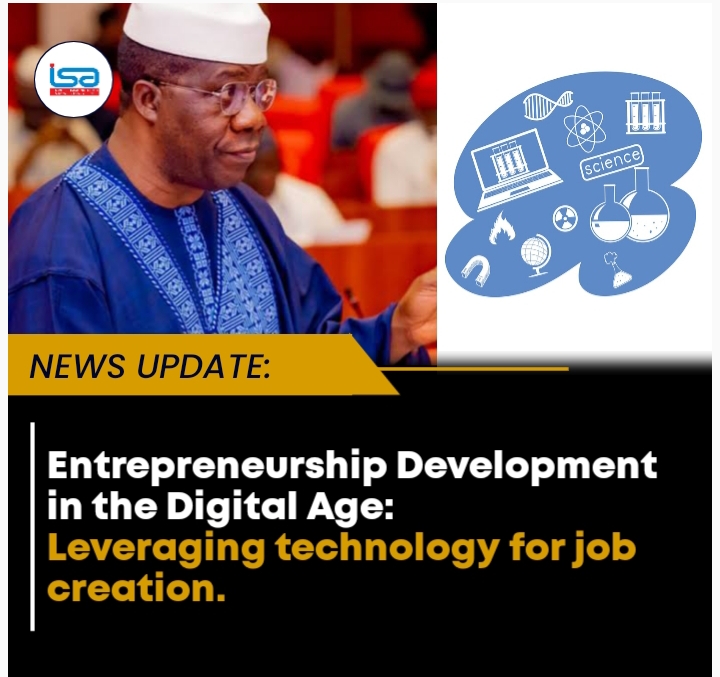
ENTREPRENEURSHIP DEVELOPMENT IN THE DIGITAL AGE: LEVERAGING TECHNOLOGY FOR JOB CREATION


TEXT OF THE SPEECH DELIVERED BY THE LEADER OF THE SENATE, FEDERAL REPUBLIC OF NIGERIA, SEN. (DR.) MICHAEL OPEYEMI BAMIDELE, CON, AT THE 37TH CONVOCATION LECTURE OF YABA COLLEGE OF TECHNOLOGY, YABA, LAGOS STATE
PREAMBLE
It is my great pleasure to explore this medium in expressing my heart-felt gratitude to the Governing Council and the Management of the Yaba College of Technology for this honour of invitation as a Guest Lecturer on this auspicious occasion of the 37th Convocation Lecture.
To start with, I wish to profoundly appreciate the esteemed Rector of this noble institution, Dr. Engr. Ibraheem Adedotun Abdul. It is my pleasure to also acknowledge the presence of the distinguished members of the Governing Council, led by my dear esteemed brother, Prof. Ishola Owa Afolabi, top Government functionaries and other state actors, captains of the industry and stakeholders of the organized private sector, entrepreneurs in the digital end creative economy sector, erudite scholars, Heads of Departments, Chief Lecturers, Senior Lecturers and other academic and non-academic staff of this institution who are seated here today. I thank you all for honouring other guests and I with your presence. To you all, I am deeply indebted, much as I assure you that I am not taking this uncommon honour for granted.
Equally, I profoundly congratulate the Management of Yaba College of Technology for the huge success of this convocation ceremony. This is a landmark achievement and a great milestone in the history of this noble institution, and I am proud to associate with your unique status as the oldest Federal Polytechnic in Nigeria, a giant incubator of technical knowledge and the foremost cradle of innovative enterprise in Nigeria.
Over the years, the priority that Yaba College of Technology attached to the development of technology, creative innovation and entrepreneurship training cannot be over emphasized, and this, indeed, is an eloquent testimony to the depth of the vision of our past leaders who played vital role in the establishment of this noble institution. It is a demonstration of their ability to see ahead and readily admit that the greatness of our future as a nation largely depends on the extent to which our youth can create wealth through the deployment of their diverse skills and innovative ideas. Apart from helping to curb the menace of massive unemployment among our graduates and young school leavers, it also gives them the capacity to gainfully earn income, become financially self-reliant and even create job opportunities for others. According to the historical record, Yaba College of Technology was created to provide full time and part time courses of instruction and training in technology, applied science, commerce and management, agricultural production and distribution; and for research. Furthermore, this institution was established to produce technical manpower for Nigeria’s economic and social development, aligning with national industrialization and vocational needs. It aims to link with commerce and industry, encourage innovation, applied research and entrepreneurship via its Centre for Entrepreneurship development.
All over the world, it is no more realistic for Governments to provide white collar jobs for all the young graduates from the universities, polytechnics, technical colleges and other tertiary institutions. The contemporary trend is that Governments are seriously looking for ways to prune down the cost of governance and are taking bold measures to replace humans with high tech machines and artificial intelligence. The new wave of technological revolution and the attendant emergence of digital economies around the globe is a pointer to the fact that nations that are determined to survive must prioritize the impartation of innovative knowledge and technical skills in their young people. You will agree with me that this is the secret and the real strength of the Asian tigers for which the rest of the world have continued to adore them today.
To attain a similar feat in Nigeria, nay Africa, our policy makers and state actors must prioritize entrepreneurship training by ensuring that our educational curricular from the primary to tertiary levels incorporate the development of technical skills, creative innovation, digital education, problem-solving skills, the impartation of managerial capacity as well as interpersonal relationship development. This is the future we all envisage, this is the future we look forward to, and Nigeria, the supposed giant of Africa, cannot afford to be left behind.
It is for this ample reason I am particularly enthused by the choice of the topic for which I have been commissioned to engage this highly cerebral gathering of erudite scholars and well accomplished entrepreneurs and seasoned professionals, namely: “Entrepreneurship Development in the Digital Age: Leveraging Technology for Job Creation”. For a nation whose past history is ridden with sad tales of widespread poverty, mass unemployment, economic uncertainty, extremely low productivity and youth restiveness, there is no better time to invest our quality time in deepening advocacy for digital economy, technological innovation and wealth creation than now.
Today, I would like to explore with you how, in our Nigerian context, the convergence of youth energy, digital technology and entrepreneurial initiative presents both a challenge and a golden opportunity — for job creation, economic transformation and national renewal.
The Nigerian Context: Youth, Jobs and Digital Change
Nigeria is among the world’s youngest nations: the median age of Nigerians is about 17 years. Yet, despite this youthful energy, we face troubling employment realities. The International Labour Organization (ILO) reports youth unemployment in Nigeria at around 6.5 %, with informal employment dominating at 93 %. Furthermore, over half of young Nigerians (aged 18-35) say they are either unemployed or underemployed. Many of our micro-businesses are born out of necessity: a report shows that 51.6 % of informal businesses in Nigeria were started simply due to unemployment. These statistics tell us that we are sitting on immense human potential — but much of it is either under-utilised or channelled into survival rather than value-creation.
However, simultaneously, we are witnessing rapid digital transformation. The tech-startup ecosystem in Nigeria raised over US$400 million in funding in 2024. For example, the fintech sector alone attracted more than US$2 billion in 2024. It is an incontrovertible fact that the ICT sector in Nigeria contributes around 19 % of the Gross Domestic Product (GDP) and is projected to rise further. We are therefore, at a juncture where youth energy, technological infrastructure, and entrepreneurial drive can converge if steered well and deployed in a most scientific manner.
The Promise of Entrepreneurship in the Digital Age
At its core, entrepreneurship in the digital age means leveraging digital technologies (internet, mobile, data analytics, platforms, blockchain, etc) to create new businesses, new value chains and new jobs. In Nigeria, this offers distinct advantages. Some of the benefits readily offered by digital technologies include, but not limited to the following:
i. Low marginal Cost of Entry: Digital businesses often require less physical infrastructure (for example online services, mobile apps, e-commerce).
ii. Scalability and Reach: With mobile penetration and internet growth, even rural and underserved areas can be served.
iii. Access to Global Markets: A Nigerian entrepreneur need not only serve Nigeria — they can access African neighbours, diaspora markets or even global customers.
iv. Innovation and Differentiation: The digital age favours agility, creativity and new business models, where we can leverage our local insights and contexts to create solutions that matter.
v. Job Creation Potential: Beyond the founder’s role, digital enterprises create jobs for developers, content creators, customer service, logistics, marketing and support staff; these are roles not traditionally available in many local communities.
For example, the web3 developer sector in Nigeria is growing rapidly. Nigeria alone contributed 4% of all global new Web3 developers, with many under 27 years old. In other words, this is a moment when we can turn digital disruption into digital opportunity.
Key Areas of Opportunity for Job Creation through Digital Technology
Some specific domains where entrepreneurship and technology intersect and where job creation is particularly ripe in Nigeria are itemized below:
a. Fintech and Digital Finance
With the fintech investments and adoption we noted, there is strong demand for solutions in payments, lending, insurance, financial inclusion and remittances. Entrepreneurs in these areas can build platforms, develop apps, provide services and hire tech and support staff.
b. E-Commerce and Logistics
All digital logistics services such as digital marketplaces, delivery networks, warehousing, fulfillment, last-mile delivery support jobs beyond simply coding. For example, a startup linking rural producers to urban markets creates jobs in rural sourcing, logistics, platform maintenance, customer service, etc.
c. Digital Services and Remote Work
Web development, design, data analytics, digital marketing, content creation — as internet access rises, many Nigerians can serve not only local clients but global ones. Entrepreneurship here means building service agencies, freelancing platforms, training centres.

d. Agri-Tech / Food-Tech
Technology applied to agriculture such as digital marketplaces for farm produce, IoT sensors, supply-chain transparency, value-added processing. All of these can spawn new enterprises and take many young people out of subsistence into growth-oriented roles.
e. Creative Industries and Media
Nigeria’s film, music, fashion and cultural industries are increasingly digital, featuring digital distribution, streaming and social media marketing. Entrepreneurs in this space create jobs in production, editing, promotion, platform operations.
f. Emerging Technologies – AI, Blockchain, IoT
While still nascent, the fact that many Nigerian developers are entering web3 and such means we have a foot in the door. New business models around blockchain, smart contracts, decentralized platforms can generate high-skill jobs and exports of tech services.
Enabling Conditions for a Prosperous Digital Economy
Distinguished Guests, Ladies and Gentlemen, you will agree with me that opportunity is not enough, we must build the enabling ecosystem for a prosperous digital economy. Below are some of the decisive measures that must be taken to build a competitive digital ecosystem.
i. Digital Skills and Human Capital: The government’s launch of the Nigerian Youth Academy (NiYA) to train in digital literacy, technical skills and entrepreneurship is a step in the right direction. Businesses, education providers, hubs all must work to ensure that our youth are equipped for the digital world.
ii. Infrastructure: Reliable internet access, broadband coverage, electricity, digital payments infrastructure, data centres – all of these underpin digital entrepreneurship.
iii. Access to Finance: Start-ups and small digital enterprises need seed capital, venture funding, micro-loans, and support programmes. The fact we already raised hundreds of millions in tech investments is encouraging. But many early-stage entrepreneurs still struggle.
iv. Regulatory and Policy Framework: Government policies that support innovation, reduce unnecessary regulatory burden, ensure data protection, digital rights, and promote digital economy are vital.
v.Incubators, Innovation Hubs, Mentorship Networks: Hubs act as catalytic platforms — and in Nigeria we now have many of them, acting as launch pads for digital entrepreneurs.
vi. Market Access and Export Orientation: Entrepreneurs must look beyond local markets and leverage digital global platforms.
Government and private sector must help facilitate access, export of services, removal of trade barriers.
vii. Culture of Innovation, Risk-taking and Entrepreneurship: We must value entrepreneurship, accept that not all businesses will succeed but learning leads to success. Schools, media and policy must support this mindset.
The Challenges We Must Address
As we embrace these opportunities, we must also confront the obstacles. Some of the challenges include the following:
a. Skills Mismatch: Many young Nigerians have theoretical qualifications but lack industry-relevant digital skills.
b. Early-Stage Funding Gap: While large funding rounds exist, seed and early-stage startups still face capital constraints, especially outside fintech.
c.Infrastructure Deficits: Electricity, internet access in rural and underserved areas remain weak — limiting digital entrepreneurship’s reach.
d. Regulatory Complexity: Some digital entrepreneurs face uncertain or changing regulatory regimes, which can dampen innovation.
e. Socio-Economic Barriers: Access to digital technology is uneven; women, persons with disabilities, rural youth may be excluded.
f. Scaling Challenges: Many digital businesses find it hard to scale from local to national or regional markets; logistics, talent and systems become bottlenecks.
g. Informality and Survival-mode Entrepreneurship: As we saw, over half of informal businesses were started due to unemployment rather than innovation. We need to transition from survive-to-thrive.
We must face the bitter truth that addressing these challenges is not optional, our readiness to nip these challenges in the bud will go a long way to determine whether our digital-age entrepreneurship can become transformative or simply anecdotal.
Strategic Recommendations
Based on the foregoing, below are strategic recommendations for all the various stakeholders: Policy makers, Private Sector, Educators, and Entrepreneurs themselves:
For Government and Policy Makers:
The Federal Government and State Governments must prioritize digital skills training at basic digital literacy, coding, data thinking in secondary and tertiary education, and in the technical and vocational education programmes. As a follow up to the training, they must provide seed-funding and incentives for digital startups, especially outside major hubs, including in rural and semi-urban areas.
In addition, Government institutions must strengthen the relevant digital infrastructure such as broadband rollout, electricity reliability, digital payments coverage to ensure digital entrepreneurship can reach all regions. Governments should also simplify the regulatory regimes for digital businesses; create sandboxes for experimentation; provide tax incentives for early-stage tech ventures.
In order to deploy digital economy in creating massive jobs and removing the mass of the people from the labyrinth of the poverty cycle, it is expedient that Government at all levels should encourage inclusive entrepreneurship. We must ensure all citizens-women, city-based young school leavers, persons with disabilities and rural youth have access to digital entrepreneurship opportunities.
To this extent, we must treat digital-entrepreneurship not as a niche, but as central to Nigeria’s job-creation strategy. It is on this strategic note that Government institutions must mobilize resources, coordinate across ministries (education, industry, communications) and build the national ecosystems that are capable of fostering a competitive, virile and prosperous digital economy.
For the Private Sector and Ecosystem Players (Hubs, Incubators and Investors):
It is imperative for them to partner with educational institutions to link curriculum to industry-relevant digital skills and provide internships/apprenticeships for hands-on experience. The Private sector should also focus on mentorship and networks by pairing young digital entrepreneurs with experienced ones; creating peer communities; facilitating access to markets. In addition, they should deploy venture capital and angel funding models tuned to early-stage Nigerian digital entrepreneurs; and they must encourage mentoring alongside funding.
The private sector should invest in regional hubs. Their investments should not just be limited to Lagos State and Abuja but they should also tap into talents across Nigeria and reduce regional disparities. The sector must expand its vision beyond Lagos State and fintech. |It must think out of the box and explore other tech climates such as agritech, healthtech, creatives and rural digital services. They need not invest not just in the top 10% but in the next 90% of aspiring digital entrepreneurs.
In the same vein, educators and institutions should modernize their curricula, remove outdated silos, equip students not just with certificates, but with digital competence, entrepreneurial mindset and global-market awareness.
For Entrepreneurs themselves:
Entrepreneurs in the digital economy sector must embrace lifelong learning because digital technologies evolve quickly. Technological innovations advance with speed light. Therefore, they must be consistent in learning, research, discovery and innovation. In other words, they must stay current in tech trends such as AI, IoT, blockchain, data analytics and so on.
It is also instructive for them to focus on solving real problems. Across the globe, the most sustainable digital businesses address real needs, whether in finance, agriculture, logistics, health and education.
Digital entrepreneurs must also prioritize the need to build on global scale. From the beginning, they should plan how their business can scale beyond the local vicinity, how it can export services or leverage digital platforms globally. It is on this note that they must build resilient business models by diversifying revenue streams, manage costs and think of digital plus offline synergies (for example e-commerce plus logistics).
More importantly, digital entrepreneurs should, as a necessity, collaborate and invent sustainable partnership with other startups, with Government programmes and international networks. They must realize the salient truth that no entrepreneur thrives alone.
THE ROLE OF THE NATIONAL ASSEMBLY IN LEVERAGING TECHNOLOGY FOR JOB CREATION
The National Assembly, as the country’s apex legislative institution, holds immense power to shape digital-age policies and institutions that can unlock massive job creation in Nigeria. Below is a comprehensive, practical breakdown of how the National Assembly can leverage digital technology directly and indirectly to drive employment on a large scale.
Legislative Leadership: Making the Digital Economy a Core National Priority
The first step is visionary legislation that places the digital economy at the centre of Nigeria’s development and job creation strategy.
In ensuring the growth of a competitive and prosperous digital economy that is capable of fostering massive job creation, it has become imperative for us to enact a National Digital Economy and Employment Act which provides a coherent legal framework. This will create an enabling legal regime for the flowering of digital practices with the attendant influx of young, but highly skilled entrepreneurs in the digital and creative economy sector. For us to maximize the potentials of digital industry in Nigeria, we must invent enabling laws to mainstream digital skills training into the teaching curricula at primary, secondary and tertiary levels. More importantly, we must formulate policies that incentivize digital entrepreneurship and innovation and we must create digital employment zones and hubs across States in the Nigerian federation. It is also expedient for us to institutionalize digital job creation targets across Government Ministries, Departments and Agencies (MDAs). To achieve all these legislative frameworks and policy objectives, there is an urgent critical need for each of the two chambers in the National Assembly, to create a Standing Committee on Digital Economy and Jobs Creation. This, invariably, are the parliamentary committees focused on monitoring digital-sector growth, investments and job creation. The committee would be expected harmonize legislation across ICT, labour, trade and education and to always consider other relevant issues emerging from the digital economy sector in Nigeria.
In a nutshell, some prospective areas of intervention by the National Assembly to maximize the latent potentials and harness the enormous human resources in the nation’s digital and creative economy include, but are not limited to the following measures:
a. Digital Skills Development through Legislative Mandates
Nigeria’s biggest opportunity lies in turning its youthful population into a digitally skilled workforce. The National Assembly can mandate digital literacy as a basic right and educational requirement. To this extent, the Universal Basic Education Act will have to be amended to incorporate digital practices such as coding, data literacy and digital entrepreneurship from primary school upwards.
b.Establishment of a National Digital Skills Fund
This will be funded by a small levy on telecommunications and digital service providers, to train at least 5 million youth in high-demand tech skills, such as AI, cloud computing, cybersecurity, UI/UX design, and data analytics.
Furthermore, the National Assembly can create legislative and policy frameworks that promote partnerships between local tech hubs and tertiary institutions to ensure that universities are linked to innovation hubs and startups, thereby promoting internships, research-to-market initiatives and job-ready graduates.
c. Using Digital Platforms for Inclusive Employment
The National Assembly can leverage digital technology itself to drive job creation through its own programmes and influence. For example, the National Assembly can embark on laudable initiatives such as:
i. The Launching of a National Digital Employment Portal: This is a centralized, government-backed platform where youth can register for digital-skills programs, remote-work opportunities, internships, and digital-service contracts. This portal could link federal and state ministries, private firms, and NGOs, similar to India’s Digital Employment Exchange.
ii. Supporting Remote Work Infrastructure Legislation: This is achieved through the enactment of laws enabling Nigerians to legally and securely work for international clients from homes, thereby ensuring digital freelancers can receive payments, pay taxes and enjoy social protections.
iii. Digital Infrastructure Expansion through Public–Private Partnerships: Without affordable internet and reliable power, the digital economy cannot thrive. Therefore, the National Assembly must prioritize funding for broadband and rural connectivity projects and mandate annual infrastructure reports from Nigerian Communications Commission (NCC) and the National Information Technology Development Agency (NITDA). Also, the National Assembly must conceive legislative frameworks that can provide tax incentives for telcos to encourage the expansion of 4G/5G to underserved areas.
iv. Supporting local production of ICT equipment: The National Assembly can legislate open access to shared digital infrastructure and also encourage infrastructure sharing among telecoms and Internet Service Providers (ISPs) to lower costs, thereby enabling startups and small digital firms to operate affordably.
iv. Financing and Incentivizing Digital Entrepreneurship
Digital startups are the biggest job multipliers.
The National Assembly can use fiscal policy to fuel them by passing the Startup Investment and Venture Capital Incentive Bill, providing tax breaks for investors funding early-stage digital startups, encouraging pension funds and public Banks to invest small percentages in tech startups, simplifying startup registration and intellectual property protection and strengthening the implementation of the Nigeria Startup Act (2022) through oversight and amendments ensuring that every State across the nation operationalizes startup hubs, seed funds and incubation centres.
v. Promoting E-Government and Digital Public Services
By digitizing its own operations and those of Government agencies, the National Assembly can create thousands of tech jobs and boost productivity. Some of the key opportunities in this regard include the lofty measures itemized below:
1. Paperless Parliament Initiative: The National Assembly can adopt a fully digital legislative workflow such as e-records, e-voting, e-procurement, thereby employing Nigerian software developers, cybersecurity experts and IT maintenance staff to drive the initiative.
2. Digital Procurement Reform: National Assembly can mandate e-procurement for all Government contracts. This will require software firms, digital auditors, and support staff, which will directly create jobs and reduce corruption in Nigeria.
3. E-governance Services: National Assembly can make laws that will make all Federal and State services such as company registration, taxes, driver’s licenses, health insurance to be accessible online. This can create tens of thousands of tech-support, software-development and data-management roles.
4. Support Emerging Technologies for New Sectors: The National Assembly can guide Nigeria toward the frontier technologies where the next generation of jobs will emerge. Some of the key areas of prospective intervention are:
a. Artificial Intelligence (AI): We must establish a National AI Council to set ethical guidelines, support AI research hubs, and incentivize Nigerian AI startups.
b. Blockchain and Web3: The National Assembly must legalize and regulate blockchain applications in identity management, agriculture, logistics and financial inclusion, thereby helping local developers build legal businesses and attract global contracts.
c. GreenTech and AgriTech: National Assembly must encourage climate-tech entrepreneurship through green bonds and innovation grants — supporting startups in clean energy, waste recycling, and precision agriculture.
5. Oversight and Accountability for Job Impact
Finally, the National Assembly should measure and enforce accountability for digital job creation by mandating annual “Digital Jobs Scorecards” from Government Ministries, Departments and Agencies, thereby tracking how many jobs were created through digital programs. It must also ensure that 5–10% of National capital budgets directly support ICT-enabled enterprises and digital skill initiatives. We must hold public hearings with youth and tech stakeholders to evaluate Government performance and gather fresh ideas.
6. Direct Job Creation through Legislative Innovation
The National Assembly can also create jobs internally by modernizing its own ecosystem. This can be achieved by developing an in-house Parliamentary Digital Innovation Hub, to be created as a space for youth tech interns to design tools for legislative transparency and data analysis. Also, it is high time we began to hire Nigerian software firms to build and maintain the National Assembly’s digital systems, rather than outsourcing abroad.
More importantly, we must partner with National Information Technology Development Agency (NITDA) and the National Agency for Science and Engineering Infrastructure (NASENI) to sponsor annual “Hack the Assembly” competitions for Nigerian youth, thereby inviting them to propose digital solutions for governance.
Conclusion
My solemn appeal to the young Nigerians with ideas in their notebooks, laptops, mobile phones is that Now is your time! The digital age has lowered barriers across the globe. You have access to worldwide customers, remote work possibilities as well as online learning platforms. Therefore, you need not wait for permission, I implore you to Start Now. Be bold. Do not be afraid of making mistakes but be consistent in learning, research, discovery and innovation. Your success will not only be your own, but rather, it will create jobs, it will generate wealth, it will influence your community and, essentially, it will shape our nation.
It is instructive to note that entrepreneurship development in the digital age is no longer a luxury, it is an imperative for Nigeria. Fortunately, we have an explosively growing youth population, an evolving digital ecosystem and the global momentum. But we must harness it smartly.
The National Assembly is ready to further reposition itself as a digital age job engine. In the way the National Assembly has embraced digital transformation, it will soon become a massive catalyst for employment in Nigeria. By passing forward-looking laws, enforcing digital infrastructure development, promoting inclusive digital skills and modernizing governance, it is my strong conviction that the Nigeria Assembly can help create millions of sustainable jobs in tech, services, agriculture and so on. In a nutshell, the National Assembly will further legislate for inclusion, invest in innovation, digitize governance and empower the youth for massive exploits in the nation’s digital economy. With these actions, I have no doubt that the National Assembly can turn Nigeria’s digital potential into national prosperity.
To this extent, if we leverage technology with purpose, we will create jobs, I mean many jobs and sustainable ones at that. These are jobs that have the capacity to empower Nigerians, uplift communities and contribute to economic transformation. Ladies and Gentlemen, we must remember that entrepreneurship does not simply create wealth for the few when harnessed well, it multiplies opportunities, builds capacity, strengthens resilience and promotes dignity of work.
Let us therefore commit, as Government, private sector, educational institutions, and as individual entrepreneurs, to seize this moment.
May we look back in five years and say: “We chose to act. We leveraged technology. We built jobs. We lifted lives. We empowered Nigeria”
I profoundly thank you all for your esteemed audience and patience. I sincerely wish you a very stimulating and refreshing convocation ceremony and may the good Lord grant us journey mercies to our different destinations.
Sen. (Dr.) Michael Opeyemi Bamidele, CON
Leader of the Senate, Federal Republic of Nigeria
National Assembly Complex
Three Arms Zone
Abuja.
*#EkitiSummitNews #MOB #SenateLeader*