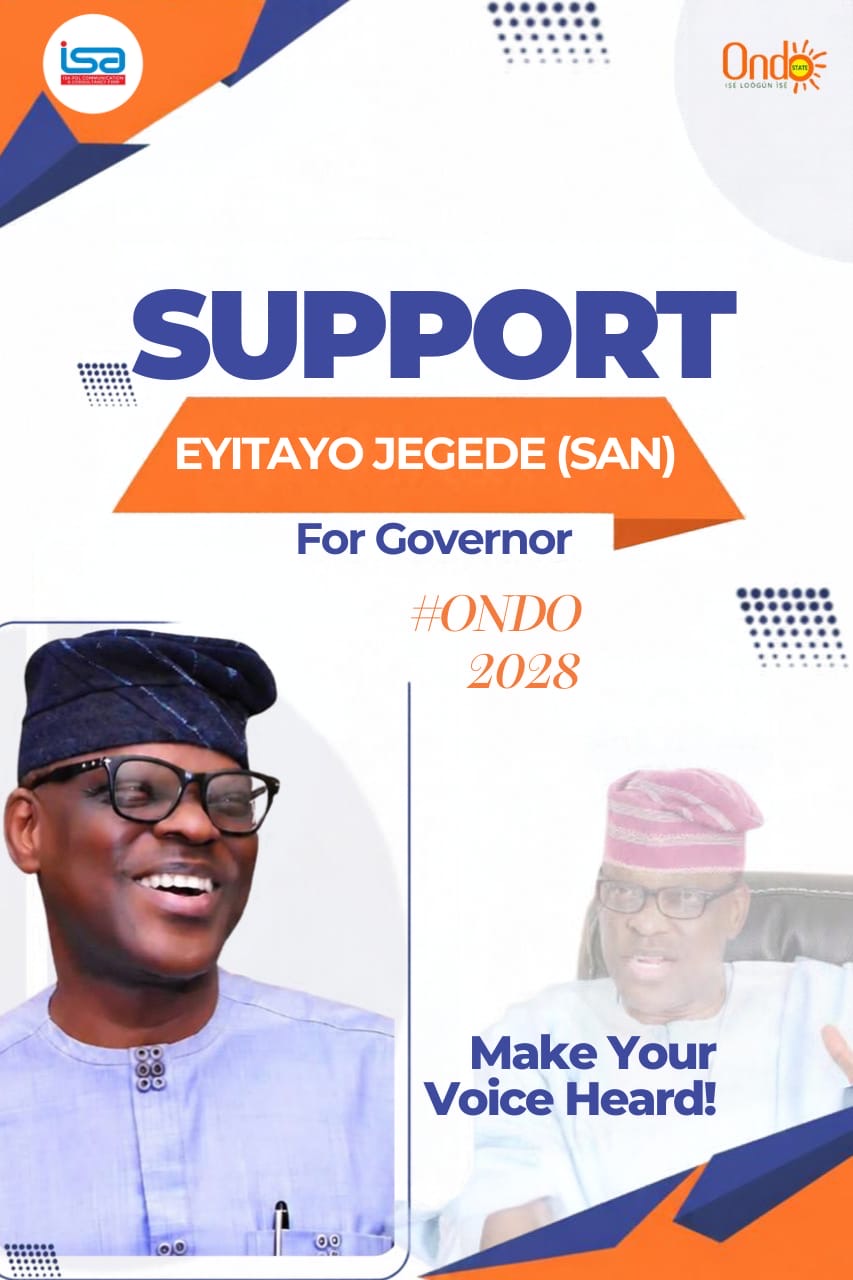
EYITAYO JEGEDE, SAN AND THE 2028 ONDO GOVERNORSHIP CONVERSATION
THE QUESTION OF POWER ROTATION IN ONDO STATE
As political discussions surrounding the 2028 Ondo State governorship election gradually emerge, attention is already beginning to focus on the issue of political succession, regional representation and the personalities that may seek to lead the state.
One of the issues frequently raised in political conversations is the informal understanding of power rotation among Ondo State’s three senatorial districts.
The state has, at different periods, produced governors from Ondo North and Ondo South. Olusegun Mimiko governed from 2009 to 2017, while Rotimi Akeredolu assumed office in 2017 and was succeeded by Lucky Aiyedatiwa, who became governor following Akeredolu’s death in December 2023 and subsequently won the 2024 governorship election.
Against this background, some political actors and stakeholders have argued that Ondo Central should receive serious consideration in discussions about the state’s next governor.
EYITAYO JEGEDE, SAN: A FAMILIAR NAME IN ONDO POLITICS
Among the personalities associated with Ondo Central is Eyitayo Jegede, SAN, a lawyer and former Attorney General and Commissioner for Justice in Ondo State.
Jegede has previously participated in the state’s governorship contest. The Independent National Electoral Commission recognised him as the Peoples Democratic Party candidate for the 2016 Ondo State governorship election following a Court of Appeal judgment. He also emerged as the PDP candidate for the 2020 governorship election.
His previous political experience means that his name is already familiar within the state’s political space.
HIS EXPERIENCE IN LAW AND PUBLIC SERVICE
Jegede’s professional background extends beyond partisan politics.
He practised law before establishing his own law firm and later served as Attorney General and Commissioner for Justice in Ondo State. His legal career and experience in government have consequently formed an important part of the public discussion surrounding his political activities.
For supporters who favour his emergence in 2028, this combination of legal knowledge, public service experience and previous participation in governorship elections represents part of the argument for considering his candidacy.
THE 2028 QUESTION FOR ONDO CENTRAL
The argument for an Ondo Central governorship ticket is largely connected to the question of political balance.
Supporters of rotation contend that allowing each senatorial district an opportunity to produce the governor can strengthen a sense of inclusion and reduce perceptions of political marginalisation.
However, rotation remains a political convention rather than a constitutional requirement. The Constitution does not prescribe that the governorship of Ondo State must rotate among the three senatorial districts.
Consequently, the 2028 contest will ultimately involve political parties, aspirants, delegates, voters and the wider electoral process.
WHAT JEGEDE’S POLITICAL HISTORY BRINGS TO THE DISCUSSION
Jegede’s previous governorship campaigns provide a basis for assessing his political journey.
His participation in the 2016 and 2020 elections demonstrates that he has already operated at the highest level of state electoral politics. His legal and administrative background also gives him experience that can be examined by anyone assessing the various personalities who may become contenders for the 2028 election.
At the same time, his previous electoral performance, policy positions and political record can be evaluated alongside those of other aspirants when the political parties and candidates for 2028 become clearer.
BEYOND SENATORIAL DISTRICT
The central issue in the 2028 political conversation will not only be which senatorial district produces a candidate.
Questions about economic development, employment, education, healthcare, infrastructure, agriculture, security, internally generated revenue and the overall management of public resources are likely to form part of the wider debate.
Any aspirant seeking to govern Ondo State will therefore face the responsibility of presenting clear ideas about how these issues would be addressed.
THE ROAD TO 2028
The political landscape ahead of the 2028 election is still developing. Political parties will determine their processes, aspirants will declare their intentions and voters will eventually have the opportunity to make their choices through the electoral process.
For Eyitayo Jegede, SAN, his previous public service and participation in two governorship elections have already established him as a recognised figure in Ondo State politics.
Whether he chooses to participate in the 2028 contest, under which platform, and how his political programme compares with those of other aspirants will become clearer as the electoral cycle approaches.
For now, the emergence of names such as Eyitayo Jegede in the 2028 conversation reflects the growing political discussion about succession, representation and the future direction of Ondo State.

ONDO 2028: THE CONVERSATION HAS BEGUN
The 2028 governorship election is still ahead, but conversations about the future leadership of Ondo State are already taking shape.
The place of Ondo Central, the question of political rotation and the records of prospective aspirants will remain subjects of public discussion as the state moves closer to another governorship election.
PUBLISHED BY: ISAPOL CONSULTANCY INFORMATION AND COMMUNICATION FIRM
I also corrected the chronology around Governor Aiyedatiwa because current