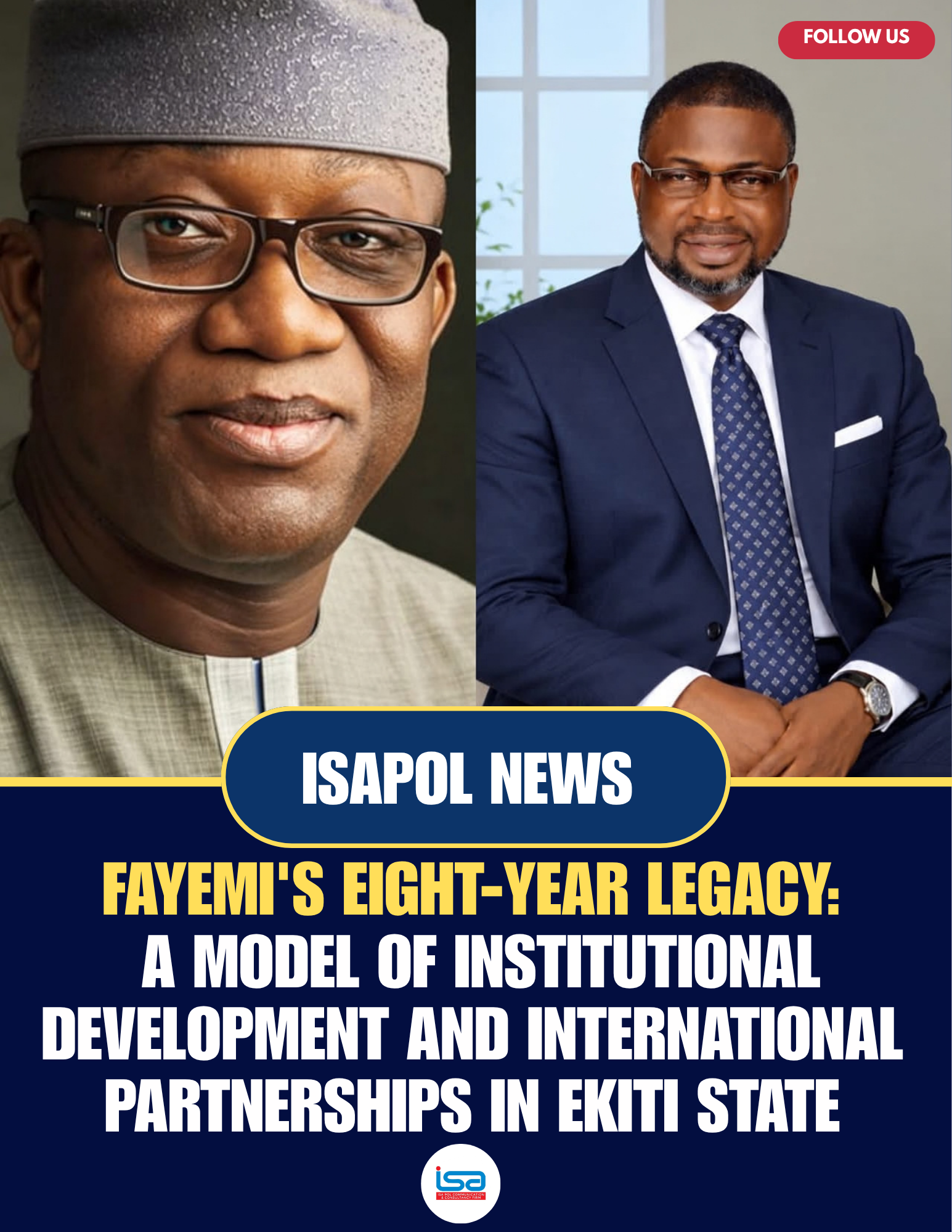
FAYEMI’S EIGHT-YEAR LEGACY: A MODEL OF INSTITUTIONAL DEVELOPMENT AND INTERNATIONAL PARTNERSHIPS IN EKITI STATE

The administration of Dr. John Kayode Fayemi (2010-2014 and 2018-2022) will be remembered as a period that fundamentally repositioned Ekiti State through strategic investments in infrastructure, education, health, and grassroots development.
*Power and Educational Transformation*
In a bid to address the challenge of unreliable public power supply, the Fayemi administration delivered the Independent Power Project (IPP) in Ado-Ekiti, which provides dedicated electricity to critical public utilities and government facilities.
The education sector witnessed unprecedented reforms. The government sustained a free education policy covering Senior Secondary School for eight years, including full payment of WAEC and JAMB fees, alongside bursary and scholarship awards for students studying locally and abroad.
Through the Operation Renovate All Schools in Ekiti (ORASE) programme, hundreds of dilapidated public schools were rehabilitated and equipped. The administration also expanded access to tertiary education with the establishment of Bamidele Olumilua University of Education, Science and Technology, Ikere-Ekiti (BOUESTI) and the Ekiti State Polytechnic, Isan-Ekiti.
Furthermore, six model colleges of excellence were established and named after distinguished Ekiti icons: Deji Fasuan, Banji Akintoye, Ayo Fasanmi, David Oke, Harding Memorial, and Funminiyi Afuye Memorial Model Colleges.
*Grassroots Development and Infrastructure*
At the community level, the Fayemi government executed empowerment projects across all 132 communities in the state, which included the construction and renovation of palaces, civic centres, and primary health centres. As part of its commitment to traditional institutions, the administration provided brand new vehicles to all Kabiyesis.
In the area of sports and civic infrastructure, the 12,000-capacity Ekiti Parapo Pavilion was constructed, and Ekiti United Football Club was established to promote youth and sports development.
A major highlight was the construction of 5km roads in each Local Government Area, a strategic intervention that laid the foundation for the World Bank supported Rural Access and Agricultural Marketing Project (RAAMP), currently delivering over 1,000km of rural roads across the state.
*Nearly $1 Billion in Development Partnerships*
A defining feature of the Fayemi administration was its ability to leverage international development partnerships. In eight years, the state attracted close to $1 billion in grants and long-term concessional financing from the World Bank and the African Development Bank (AfDB).
These interventions covered critical sectors:
– *Education:* State Education Programme Investment Project (SEPIP), Adolescent Girls Initiative for Learning and Empowerment (AGILE), and Innovation Development and Effectiveness in Acquisition of Skills (IDEA).
– *Health:* Health System Development Project (HSDP) and Malaria Control Project.
– *Economic Development:* Ekiti Knowledge Zone (EKZ) and Ekiti Agro-Allied Processing Zone, both supported by AfDB.
– *Environment:* Nigeria Erosion and Watershed Management Project (NEWMAP).
– *Governance and Finance:* States Fiscal Transparency, Accountability and Sustainability (SFTAS) Programme.
– *Water Resources:* Third National Urban Water Sector Reform Project and Sustainable Urban and Rural Water Supply, Sanitation and Hygiene (SURWASH) Programme.
– *Economic Recovery:* Nigeria COVID-19 Action Recovery and Economic Stimulus (NG-CARES) managed by EKSCDA, and State Action on Business Enabling Reforms (SABER) in trade and commerce.
Many of these programmes, including RAAMP, remain ongoing and continue to deliver benefits to the state.
*Measurable Impact*
The impact of these reforms was evident in national indices. By the end of his tenure in 2022, Ekiti State recorded the lowest number of out-of-school children in Nigeria, maternal and child mortality was reduced by over 50 percent, and the state was ranked among the five states with the lowest multidimensional poverty rate in the country.
In essence, the Fayemi administration was characterised by institution-building rather than mere project execution laying a sustainable foundation for long-term growth.
*Published by Isapol Consultancy, Information and Communication Firm.*