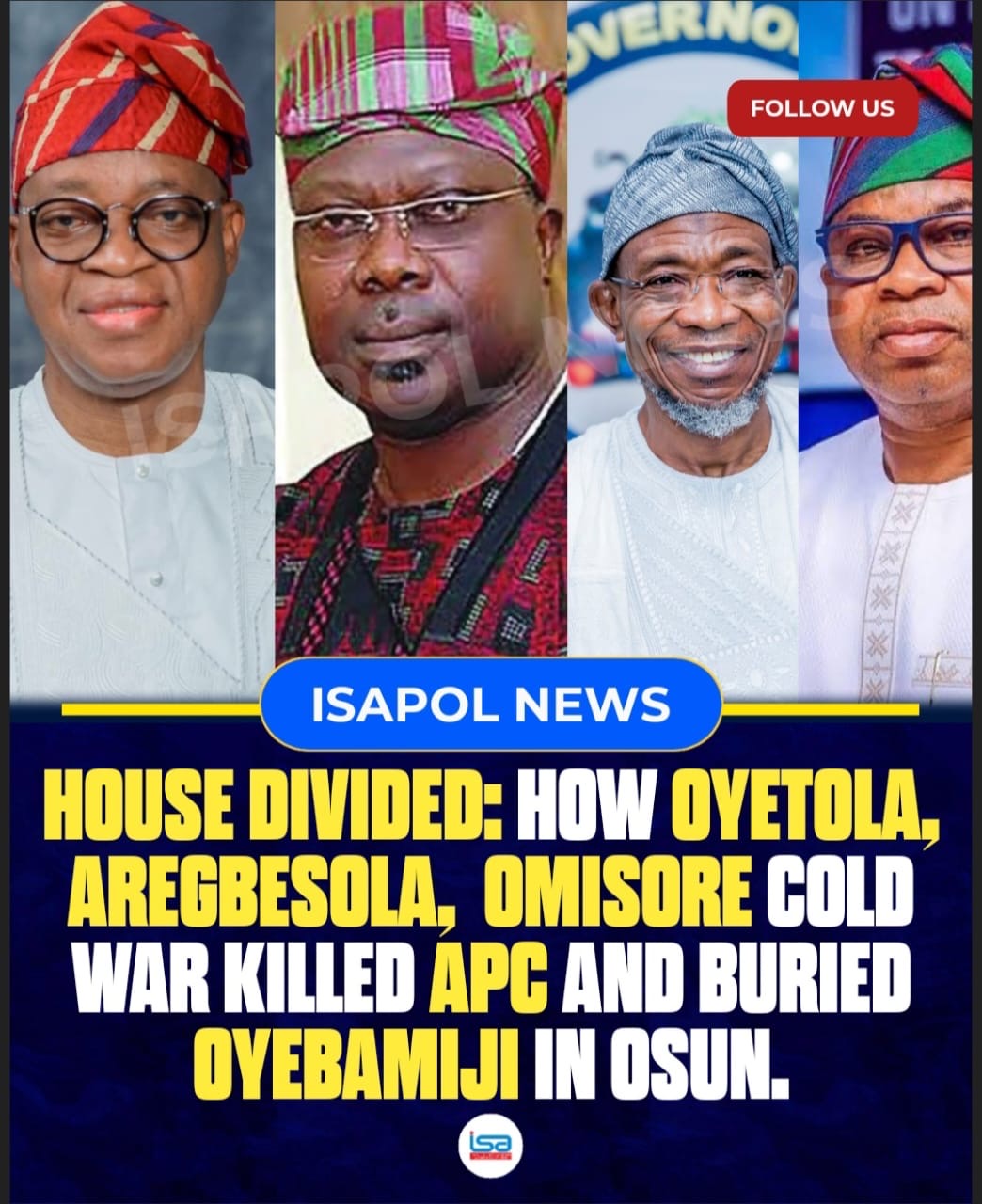
HOUSE DIVIDED HOW OYETOLA AREGBESOLA OMISORE COLD WAR KILLED APC AND BURIED OYEBAMIJI IN OSUN

The defeat of the All Progressives Congress APC governorship candidate, Bola Oyebamiji, in Saturday’s Osun State governorship election has renewed questions about the impact of internal divisions within the party.
Oyebamiji secured 444,815 votes but lost to incumbent Governor Ademola Adeleke of the Accord Party who polled 511,067 votes. Adeleke won by a margin of 66,252 votes and carried 19 of the state’s 30 local government areas, while Oyebamiji won 11.
While the result reflects the choice of voters, post election analysis has pointed to APC’s internal struggles as one of the major factors that weakened the party’s campaign.
*A Divided House*
Osun APC has faced years of disagreements among influential political camps.
The divisions became particularly visible during the 2022 governorship election when disagreements involving former Governor Gboyega Oyetola and former Governor Rauf Aregbesola were widely discussed as part of the factors affecting the party’s performance.
Four years later, the party again entered a governorship contest with unresolved relationships among some of its major political figures.
Analysis identified the longstanding rivalry involving Oyetola and former Deputy Governor and former APC National Secretary, Iyiola Omisore, as one of the major fault lines within the party.
*Oyebamiji Emerged As Consensus Candidate But Unity Never Came*
Oyebamiji’s emergence as the APC candidate was expected to give the party an opportunity to move beyond its internal divisions.
He was regarded as a candidate acceptable to different interests within the party.
However, securing a consensus candidate and achieving genuine unity across the party structure are two different things.
For the APC to defeat an incumbent, its leaders needed to translate their political structures into a coordinated statewide campaign involving ward leaders, grassroots supporters and local government structures.
The post election result suggests that the party was unable to completely turn its different political blocs into one cohesive electoral machine.
*Adeleke Maintained The Advantage*
The APC’s internal challenges were not the only factors at play.
Adeleke entered the election as the incumbent governor, giving him the advantage of an established government structure and political network.
His ability to secure 511,067 votes and win 19 LGAs demonstrates that the Accord candidate was able to build a broader electoral coalition across the state.
Oyebamiji’s 444,815 votes, however, also show that the APC remained a strong political force in Osun. The party was not overwhelmingly defeated, rather it failed to secure enough votes to overcome Adeleke’s advantage.
*The Lesson For Osun APC*
The outcome could force the APC to reconsider how it manages its internal politics ahead of future elections.
The party has experienced influential former governors, political leaders and competing tendencies, but political strength can become an electoral weakness when those structures are not coordinated.
The 2026 result therefore raises a broader question for the APC, can the party resolve its internal differences early enough to build a unified political structure before the next major election?
Oyebamiji’s defeat cannot be attributed solely to internal APC politics. Voter preferences, Adeleke’s incumbency, campaign strategies, grassroots mobilisation and the presence of other candidates all contributed to the final outcome.
However, the election has once again highlighted the potential cost of internal division. For the APC, the immediate challenge is no longer winning the 2026 governorship election. It is rebuilding unity and ensuring that its considerable political strength translates into electoral victories in future contests.
Published by isapol Consultancy information communication firm