MKO: How A Documentary Reawakened Nigeria’s Unhealed June 12 Scar

By ISAPOL MEDIA
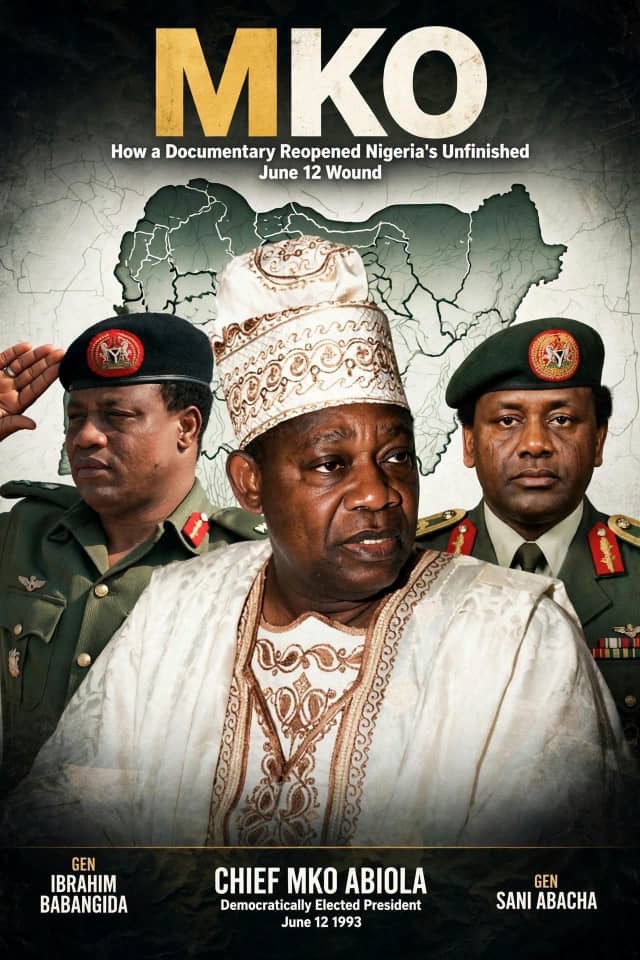
I walked into the cinema to watch ‘MKO’, the new documentary on Chief Moshood Abiola, with mixed emotions. For many of us who witnessed the 90s, the name Sani Abacha still provokes a reaction. You assume you have recovered. Then you hear the marching boots, the decrees, the political assassinations again on the screen, and you realize you have not.
Ose Oyamendan, the Nigerian-American filmmaker behind the project, achieved what many of us failed to do – he lived with history for more than ten years, interviewing major players while many were still alive, and pieced it all together.
After viewing it, three things lingered with me.
*Firstly, the transformation of Abiola himself.*
The Abiola we knew before 1993 was an establishment figure. He was the ultimate ally of government. From ITT and the huge telecommunications contracts of the 70s, to being a major financier of the NPN in 1979, to being alleged to have sponsored coups. He was not an outsider. In fact, when he declared for the presidency in 1993, activists murmured that this was IBB’s friend coming to succeed IBB.
What the documentary brilliantly captures is how power transformed him, or rather, how denial of power transformed him. Once his June 12, 1993 mandate was annulled, the establishment man turned into an anti-establishment symbol.
There is a footage in the film that sums it all up. After declaring himself President at Epetedo in June 1994, he was arrested. His aide managed to connect the BBC on phone. The anchor asked how he could still grant an interview if he had been apprehended. Abiola replied: “They have come to arrest me, not my mouth!” You laugh, but you also see bravery. This was Nigeria’s wealthiest man at that time, a man who could have said “it is the will of God” and returned home. Instead he opted for a rat-infested police detention. In one archival interview he stated, “Any sacrifice is necessary if it will enthrone democracy in Nigeria.” Imagine Aliko Dangote today swapping his private jet for a Black Maria because of an election.
Without that doggedness, we might still be having military rulers transmuting into civilian presidents like in Equatorial Guinea. Abiola forced the deadlock.
*Secondly, the Abacha puzzle is finally resolved.*
For years we argued over who actually annulled June 12. The film provides a revealing testimony from Brigadier Halilu Akilu, former Director of Military Intelligence, who rarely grants interviews. He narrated the last meeting before Babangida stepped aside in August 1993. Babangida had said all Service Chiefs would exit with him. Abacha bluntly declined. He told IBB, in essence, that he would not retire. Babangida’s reply, according to Akilu, was “good luck serving under Shonekan.”
That corroborates what Babangida wrote in his own book. It shows Abacha was not just a beneficiary of the crisis; he was an architect of it. He required the annulment to stay relevant. And he secured his ultimate prize – Head of State.
*Thirdly, the myth of America the rescuer.*
In 1993-1998, many Nigerians sincerely believed Bill Clinton would come and restore June 12. It is the same illusion some nurse today that Donald Trump will come and topple a government in Abuja. The documentary calmly demolishes it.
America spoke loudly about democracy but acted quietly about crude oil. Nigeria’s Bonny Light was too valuable to sacrifice for Abiola. The filmmakers connect the dots: the American statements, the silent oil deals, and the convenient end to the stalemate when both Abacha and Abiola died within a month of each other in 1998 under very questionable circumstances. I do not know who killed who, but their deaths served American and Western interests perfectly – the gridlock cleared for a transition they could control.
*What is the lesson for today?*
Abiola teaches two contradictory lessons that our present politicians have refused to learn.
One, principle counts. If he had compromised, there would be no May 29 as Democracy Day. And his death paved the path for power rotation. It is because a Southern Muslim won convincingly and was denied that the Northern elite conceded in 1999 that power must shift South. That gentleman’s accord still sustains Nigeria’s unity today.
Two, pragmatism counts. The Yoruba political elite before Abiola loved to remain in principled opposition. Chief Awolowo allied with minorities to attempt to win at the centre, but the figures did not add up. Nigeria is a tripod – Hausa-Fulani, Igbo, Yoruba. You need two legs to stand. Abiola in 1979 was branded a betrayer for aligning with the Hausa-Fulani. He constructed those bridges for 14 years and in 1993, it yielded results – he won in Kano, defeating Bashir Tofa in his own ward. Obasanjo in 1999 and Tinubu in 2023 won with the same formula. As I wrote in my upcoming book, no one has secured the Nigerian presidency since 1999 without being competitive in two of the three tripod blocs.
Abiola the prince turned rebel, but he was a rebel who understood political arithmetic.
Oyamendan who studied Mass Communication at Unilag has rendered a public service with this film. He got Ambassador Babagana Kingibe, Abiola’s running mate, to speak on camera about witnessing Abiola breathe his last. Many of those interviewees are now deceased.
If you are under 30 and you feel military rule is an option because civilian governance is frustrating, please go and watch ‘MKO’. It will cure you of that nostalgia. PUBLISHED BY: ISAPOL MEDIA