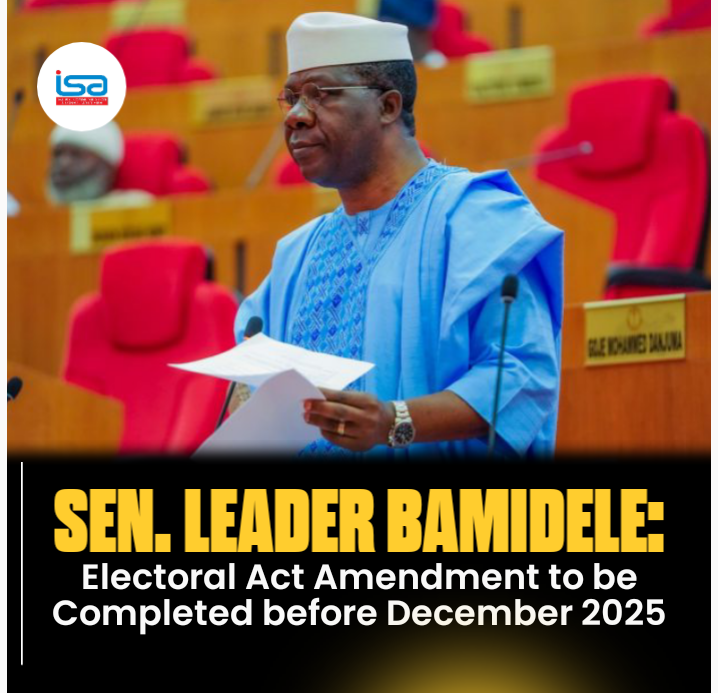
Senate Leader Bamidele: Electoral Act Amendment to Be Completed Before December 2025

Abuja, Nigeria The Leader of the Senate, Senator Michael Opeyemi Bamidele, has assured Nigerians that the ongoing amendment to the Electoral Act 2022 will be concluded before December 2025, paving the way for its full implementation during the 2027 general elections.
Senator Bamidele, who represents Ekiti Central Senatorial District, gave the assurance shortly after Senate President Godswill Akpabio read a letter from President Bola Ahmed Tinubu, requesting the confirmation of Professor Joash Amupitan (SAN) as the new Chairman of the Independent National Electoral Commission (INEC).
President Tinubu nominated Professor Amupitan, a respected Professor of Law, following the unanimous approval of his appointment by the Council of State last week. The nomination comes after the exit of the immediate past INEC Chairman, Professor Mahmood Yakubu.
Avoiding Past Mistakes
Explaining the rationale for the early commencement of the amendment process, Senator Bamidele recalled that under former President Muhammadu Buhari, the final corrections to the 2022 Electoral Bill could not be signed into law because it was transmitted too close to the general elections.
He stated:
> “Before then, we had made our first proposal, which was signed into law. However, certain observations were made especially regarding the disenfranchisement of statutory delegateswhich the National Assembly sought to correct.
Unfortunately, the then President, Muhammadu Buhari, declined to sign the correction, explaining that it came too close to the elections and he did not want his action to be misinterpreted by the public.”
The Senate Leader stressed that the present National Assembly is determined not to repeat that mistake.
> “Between now and December 2025, we will ensure that the amendment to the Electoral Act, 2022, is concluded, giving the electoral body and all stakeholders enough time to adapt before the 2027 polls,” he said.
Constitution Review on Course
Speaking further, Senator Bamidele, who also serves as Vice Chairman of the Senate Constitution Review Committee, dismissed fears that the Presidency might resist the ongoing review of the 1999 Constitution (as amended).
According to him, there is strong synergy between the legislature and the executive on the review process.
> “I do not envisage any resistance because public institutions are working hand-in-hand with the National Assembly to ensure a successful review of the 1999 Constitution. We are aligning with global best practices in this exercise,” he noted.
Opposition Criticisms Expected
Addressing criticisms from opposition parties, the Senate Leader maintained that such reactions are a normal feature of democracy.
> “No matter how well a government performs, the opposition will never acknowledge it because their goal is to reclaim power. They would rather see the ruling party divided, but the All Progressives Congress (APC) remains united and focused on delivering good governance,” Bamidele asserted.
10th Senate’s Legislative Agenda
Highlighting the priorities of the 10th Senate in its third legislative year, Bamidele said that lawmakers are currently focusing on critical national issues, including the Electoral Act amendment and the Constitution review.
He explained that the National Assembly has adopted a proactive approach to legislative engagements by working closely with the executive early in the process.
> “We are now at the stage of strategic engagements, most of which will take place behind closed doors. We intend to engage the presidential team early instead of waiting until all bills are ready. Any bill that is ready for assent will be transmitted to the President immediately,” he added.
Senator Bamidele reaffirmed the Senate’s commitment to deepening Nigeria’s democracy through timely reforms and constructive collaboration between all arms of government.
Author COMRADE IDOWU AFUYE