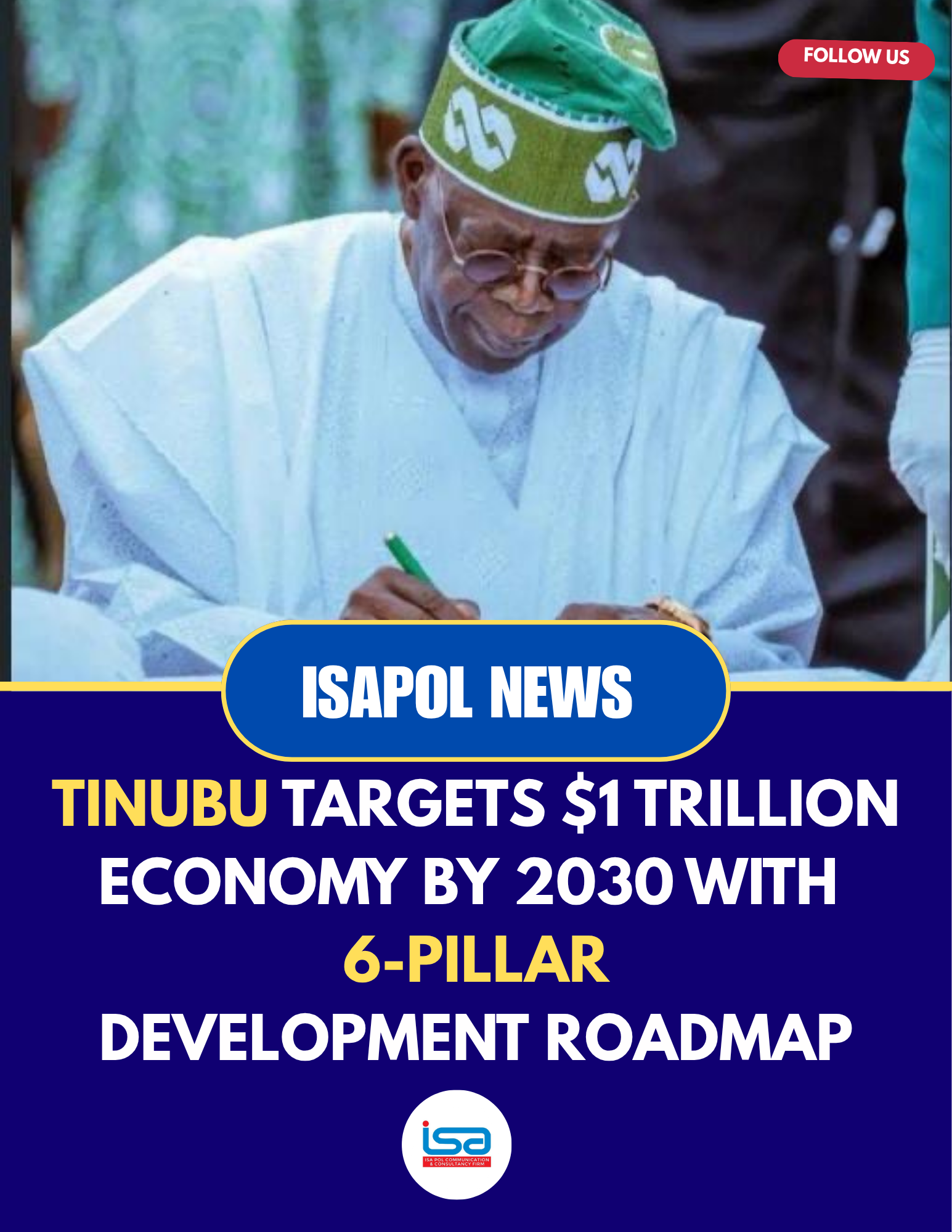
TINUBU TARGETS $1 TRILLION ECONOMY BY 2030 WITH 6-PILLAR DEVELOPMENT ROADMAP

*Abuja, September 2, 2026* — President *Bola Ahmed Tinubu* has unveiled a new national target for Nigeria: a *$1 trillion economy by 2030*, backed by a 2026–2030 development framework aimed at transforming the country into a larger, more productive and globally competitive economy.
The Presidency said the plan is not a slogan but a detailed strategy built around infrastructure, energy, production and private sector investment.
_THE 6-PILLAR ROADMAP_
*1. Maritime and Logistics Corridor*
The government plans an integrated corridor linking deep-sea ports in *Lagos, Ondo, Akwa Ibom, Port Harcourt and Calabar* to the Nigerian interior via road and rail. The goal is to position Nigeria as a maritime, industrial and logistics hub for West and Central Africa.
*2. Energy for Industrialisation*
Energy is listed as the foundation of the plan. The administration says reliable power is critical to increase manufacturing capacity and industrial output.
*3. From Consumption to Production*
The target is to reduce imports and grow agriculture, manufacturing, technology, solid minerals, petrochemicals, creative industries and other non-oil sectors as major contributors to GDP and exports.
*4. Infrastructure as Growth Engine*
Major investments are planned in highways, railways, ports, power, digital and industrial infrastructure to cut costs, speed up trade and attract investors.
*5. Private Sector Led Investment*
The Federal Government said about *86%* of the funding needed will come from the private sector. Reforms are being pushed to improve the investment climate.
*6. Macroeconomic Stability*
Officials say foreign reserves have surpassed *$50 billion* and key indicators are improving. The Finance Ministry estimates that hitting $1 trillion will require *10–12% annual growth* over the next 4 years.
_WHY THIS TARGET MATTERS_
Unlike previous plans such as Vision 2020 and Agenda 2050, the $1 trillion agenda comes with a specific dollar target, deadline and investment strategy.
“The question is no longer ‘Can Nigeria become a great economy?’ The question is ‘Can we execute the plan well enough to get there?’” the document stated.
Success, according to the government, will be measured by more electricity, more jobs, lower production costs, more factories, more exports, better roads and rail, higher incomes, stronger businesses, greater purchasing power and more investment.
_POLITICAL CONTINUITY_
The administration said it is also working to unify elite interests within the APC around the vision to ensure policy continuity beyond 2027.
Analysts, however, note that sustaining the reforms will depend on future administrations maintaining the same direction.
_CONCLUSION_
With the foundation said to be laid, the Federal Government says the focus now is on execution, continuity and patience.
A $1 trillion Nigerian economy by 2030 is no longer just an aspiration. It is now a national target.
Published by isapol Consultancy information communication firm