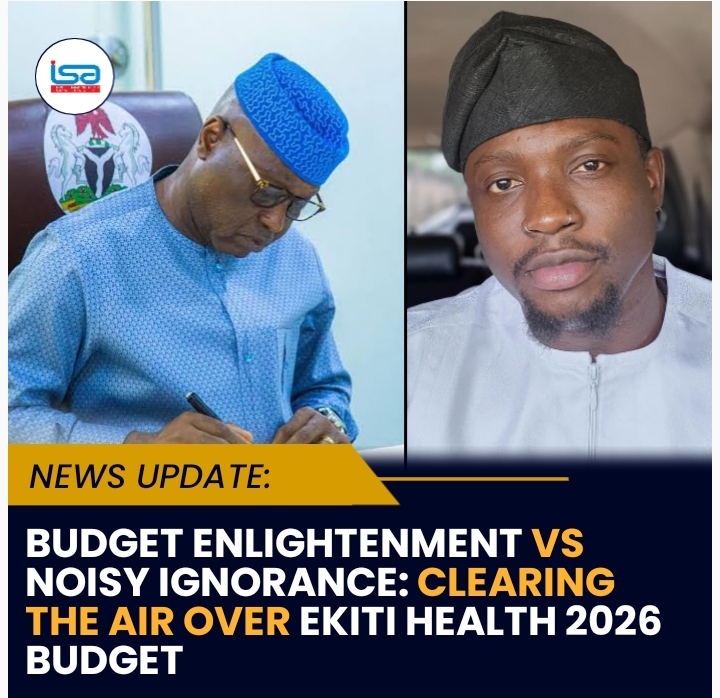
BUDGET ENLIGHTENMENT VS NOISY IGNORANCE: CLEARING THE AIR OVER THE EKITI HEALTH 2026 BUDGET


The attention of The Progress Mandate has been drawn to recent public commentary by Mr. Martins Vincent Otse, popularly known as VeryDarkMan, regarding the Ekiti State 2026 Appropriation Law and its health sector funding. While public scrutiny of government budgets is a cornerstone of democracy, the approach and substance of this intervention reveal a concerning lack of understanding of public sector accounting and budget interpretation.
The claim that sixty-eight million naira represents the total health allocation of Ekiti State is fundamentally incorrect. That figure pertains only to a narrowly defined administrative subhead within the Primary Health Care Development structure and does not reflect the state’s consolidated health expenditure. Anyone with basic familiarity with government budgeting understands that sectoral funding cannot be inferred from a single line item in isolation.
Public finance follows a structured, multi-layered approach. Health sector spending is distributed across numerous institutional votes and expenditure classifications. These include the Ministry of Health’s coordination and oversight, Hospital Management Board operations, personnel costs for doctors, nurses, community health officers, and allied professionals, capital investments in hospital construction and renovation, medical equipment and pharmaceutical procurement, disease prevention programs, maternal and child health services, health insurance support, emergency and referral services, and federally or partner-supported interventions. Only when all these allocations are aggregated can a true picture of sector funding emerge.
It is also important to highlight that Governor Biodun Abayomi Oyebanji’s administration has maintained measurable and structured interventions in the health sector. These include ongoing primary health center revitalization, upgrading of general hospitals, expanding state health insurance enrollment, strengthening community-based health delivery, recruitment and regularization of health personnel, maternal and child health improvement initiatives, sustained collaboration with federal and development partners, and the ongoing construction of an 80-bed hospital at the Ekiti State University Teaching Hospital. Sectoral progress should be evaluated by program execution and service delivery outcomes, not isolated budget fragments.
Sound budget analysis requires consolidation, cross-referencing, and a clear understanding of accounting structures. Personnel emoluments and core service delivery costs are captured under centralized schedules and are not repeated under each project line. Ignoring this framework and presenting an isolated figure as total sectoral funding is misleading, not activism.
Mr. Martins Vincent Otse’s commentary affirms the risks of forceful opinions unsupported by a full budget review. Public finance is interpreted through thorough document analysis, methodological rigor, and disciplined fiscal reasoning, not through impatience, outrage, or viral excerpts. Reaction without comprehensive review misinforms the public. Ekiti operates under lawful appropriation procedures, audit exposure, and regulated fiscal governance. It is not a banana republic.
As professional guidance, Mr. Otse is encouraged to approach future fiscal commentary with study, consultation, and technical restraint. Careful reading of appropriation documents, engagement with public finance experts, and disciplined verification of sector-wide figures will strengthen credibility and enhance advocacy. Responsible influence is built on depth of understanding, not speed of reaction, the standard expected in serious governance discourse.
Biodun Oyebanji
Dr. Olayemi Oyebanji
Bimbo Daramola
Kayode Fayemi
Government of Ekiti State, Nigeria.
Signed
Yomi OSO
Director General
Comrade Afuye Idowu
ISA POL Communication and Consultancy Firm